

Showing posts with label Facts about God. Show all posts
Showing posts with label Facts about God. Show all posts
June 30, 2014
February 25, 2014
Worshipping Lord Shiva on Mahashivaratri will lead you to Salvation!
Know More On...
Devotional Stories,
Facts about God,
Importance of Mahashivaratri,
Lord Shiva,
Mahashivratri

Lord Shiva once said, as recorded in the scriptures, that whoever worships his and Ma Parvati’s statue on Mahashivaratri and fasts will be dearer to him than his own son Kartik. The benefits that one gets from a mere glimpse of Lord Shiva are unmatchable.
Therefore, Lord Shiva’s devotees observe a strict fast on Mahashivaratri, with many people not even consuming a drop of water. Worshippers dutifully follow all the traditions and customs for the fast as they strongly believe that sincere worship of Lord Shiva on this auspicious day releases a person from all his sins and liberates him from the cycle of birth and death. As Shiva is regarded as the ideal husband, unmarried women pray for a husband like him, while married women pray for the well being of their husbands.
Devotees wake up early in the morning on Mahashivaratri, and after taking a bath and wearing fresh clothes, they visit the nearest Shiva temple, to give a ritual bath to the Shiva Lingam (with milk, honey, water, etc.). The worship continues the whole day and night. The next morning, devotees break their fast by partaking the prasad offered to Lord Shiva. Chanting of “Om Namah Shivaya” continues throughout the day and night. Belva leaves are continuously offered to the Lingam. Hymns of Lord Shiva are sung with great devotion.
Here are the methods prescribed for observing a fast and worshipping Lord Shiva on Mahashivaratri:
| Time | Offerings |
| First Quarter | Til (Sesame Seeds), Jav, Lotus, Belvapatra |
| Second Quarter | Fruit of Vijora, Lemon, Kheer |
| Third Quarter | Til, Wheat, Malpua, Pomegranate, Kapur |
| Fourth Quarter | Udadh dhal (white lentils), Jav, Moong, Shankhpushpi leaves, Belva-patra and Pakodas (fries) of Udadh |
Benefits of worshipping Lord Shiva
- Ablution of Lord Shiva is said to purify one’s soul.
- By making offerings (Naivaidya) one is said to attain a long and satisfactory life.
- By lighting a lamp, one becomes knowledgeable.
- By offering Tambul to Lord Shiva, one can get favourable results.
- One begets children by sprinkling/ pouring milk on the Shiva lingam.
- After bathing Lord Shiva with curd, one can buy vehicles.
- By offering Lord Shiva darbha (a kind of grass) mixed in water, one can get rid of diseases.
- If honey, ghee and sugarcane are offered to Lord Shiva, one can attain wealth.
- By bathing Lord Shiva with the holy water of the river Ganges, one can attain salvation.
Don't Miss to Visit Admins Youtube Video Page
February 7, 2014
Hinduism Introduction - Its Importance

It is hard to define Hinduism. It is not a religion in a narrow sense associated with the word religion. Its comprehensiveness bypasses the human mind. No single approach is able to enunciate its basic concept and philosophy. In a very broad sense Hinduism is a way of life. From time immemorial indigenous religious consciousness has continuously enriched it. It has been influenced by the aspirations and needs of the human society from time to time. It embraces the indigenous religions of India which have been modified almost continuously with the development of ideas and the needs of local communities. As a result Hinduism is a mixture of sects, cults and doctrines which have had a profound effect on Indian culture. In Spite of this diversity, there are few of its aspects which do not rely in some way or the other on the authority of Indian religious literature – the Vedas, the Epics and the Puranas.

Vedic Deities
The Vedic gods who eventually became established in India may have been the result of the fusion of ideas brought by migrants and those of the indigenous people.
These deities were defined in the Vedas, along wit Ii meticulous descriptions of the ceremonies that were intended to propitiate them.
There is a popular school of thought which disputes the theory of the migrants having brought in ideas and is of the opinion that Hinduism was highly developed much before. It is not within the scope of this book to go into this controversy.
It is evident from the Vedas that these deities were, to a certain extent, visualized as having human or animal forms. But it is not certain whether they were worshipped in the form of images. There remains the possibility, important for its effect on the later development of images, that some of the lower castes worshipped images in human or animal form and that this practice gradually spread upwards to the higher sections of society. At a much later period, the Vedic deities were given human form and reproduced as images.
In response to the forces of development, the old Vedic religion underwent several changes. These chiefly concerned the deities that were worshipped, and the forms of ritual. Some deities changed their function, or gained or lost popularity, while the powers of mediation between the deity and the devotee became monopolized by the priests (Brahmins) who alone could perform the necessary rites at the rituals. This made the deities remote and some of them acquired awesome aspects. Consequently, while many of the old deities were relegated to minor positions in the pantheon, others were elevated, and new deities were introduced. Parallel with this, and as a possible reaction against the strict orthodoxy of the the need gradually arose for a more satisfying relationship between the worshiper and the worshiped. This need for devotion (bhakti) towards a personal god stimulated the desire for images which would make the deity more approachable. Their introduction was a slow, uneven process and it is likely that images were made at first only of minor deities in the pantheon. One of the earliest references to images for worship is around the 5th century B.C. of the Yakshas (tree Spirits) and Nagas (snake gods).
Epic Deities
Further stimulus to a more personal relationship between gods and men was given by the two great epics of Indian literature, the Ramayana and the Mahabharata. The stories of these epics are secular in nature but they not only describe the feats of their heroes but refer to the influence that the gods had on their exploits. Thus the stories of the gods were supplemented and expanded as they were woven into the narratives and the heroes themselves got assimilated into Indian popular religion and became deified.
Puranic Deities
Further development of the Indian society brought about changes in religious concepts and an increase in the size of the pantheon. This grew by a process of absorption and combination, adopting popular (including female) deities into a sophisticated and well-developed assembly and merging several deities into one. Thus the minor Vedic deity Vishnu was identified with Vasudeva and another epic hero Krishna. It is likely that the ten incarnations of Vishnu that eventually became conventional were attributed to him in a similar way.
Later, Krishna himself got assimilated with a pastoral flute - playing deity and became the subject of many poems and legends. At the same time, an ancient fertility Lord Shiva, was elevated to the higher ranks of the pantheon and became a important deity with a variety of forms that gave him a popularity equal to that of Vishnu. Shiva and Vishnu were visualized as forming a triad with Brahma. But, in spite of his ancient prestige, Brahma never received the widespread adoration enjoyed by the other two gods.
Beginning about the 4th or 5th century A.D., attempts were made to create some sort of order out of the mass of myths and legends that had evolved around a large number deities. Eventually these traditional tales were incorporated into the Puranas (Ancient Stories) summing up all that was known about the gods, with their elaborate genealogies, and providing religious instructions. In consequence, many of the deities who subsequently made their appearance are the result of formalization given to them in the Puranas. At the same time a further impetus was given to Hindu mythology (and thus a corresponding increase in the number of deities) by the development of Tantrism which emphasized the cult of the female partner (shakti) in association with a male deity, often Shiva.
From the 15th century onwards a revival of interest in the bhakti movement brought about a widespread devotion to the cult of Krishna, one of the earliest gods to have human-like qualities.
The creative powers of India’s religious life have not declined but continue with the same energy as they had earlier. For example recently (in the 1960’s), in Northern India, the goddess Santoshi Mata appeared complete with her own mythology and legends.
Don't Miss to Visit Admins Youtube Video Page
February 6, 2014
One of The Best Sayings of Shiridi SaiBaba
Know More On...
Facts about God,
Facts about India,
Shiridi Sai baba,
Shiridi Saibaba Sayings,
Teachings of God

Bad thoughts separate you from others and make you forget the divinity. So you must combat evil thoughts arising in your mind.
As soon as thoughts come to you, you should not rush into action, but use your intelligence and arrive at a correct decision.
Action taken after scrutiny results in peace.
The root cause of fear in man is the absence of pure and sacred thoughts in his mind.
However learned and powerful a person be, if he is not virtuous, he will succumb to his weaknesses.
Shirdi Sai Baba
Don't Miss to Visit Admins Youtube Video Page
October 2, 2013
Special Trains for Durga Puja - DASARA- INDIA
Know More On...
Facts about God,
Facts about India,
General Information,
Special Trains

ALLAHABAD: In view of the DurgaPuja festival, The railway administration had decided to run Puja special trains during DurgaPuja. These are Kolkata-AnandVihar terminal ( Delhi) special, Sealdah-New Delhi special.
NCR spokesperson Manzar Karrar said that there is huge rush during Durga Puja festivals. The specials are being run so that passengers can get confirmed reservation
Train number 03125/03126 would run between Kolkata and Delhi (Anand Vihar Terminal). It would depart from Kolkata at 1:45 pm and go through Burdwan, Durgapur, Asansol, Dhanbad,Gomo, Kodarma, Gaya, Dehri-on-Son, Sasaram, Bhabua Road and reach Mughalsarai at 2:00 am, Allahabad at 4:35 am, Kanpur at 7:15 am and terminate at Anand Vihar Terminal at 1:50 pm. During the return journey, the train would depart from Anand Vihar Terminal at 7:50 pm and reach Kanpur at 1:45 am, Allahabad at 4:25 am, Mughalsarai at 6:45 am and terminate at Kolkata at 6:10 pm.
The train would depart from Kolkata every Saturday from October 5 to November 9 and from Anand Vihar Terminal every Sunday from October 6 to November 10. It would comprise one AC-II tier, two AC-III tier, ten sleeper and three general coaches.
Train number 03113/03114 would run between Sealdah and New Delhi. It would depart from Sealdah at 11:55 pm and pass through Burdwan, Durgapur, Asansol, Dhanbad, Gaya and arrive at Mughalsarai at 10:10 am, Allahabad at 12:15 pm, Kanpur at 3:25 pm and terminate at New Delhi at 11:30 pm. During the return journey, the train would depart from New Delhi at 11:45 pm and arrive at Kanpur at 6:40 am, Allahabad at 9:10 am, Mughalsarai at 11:50 am and terminate at Sealdah at 10:45 pm. This train would depart from Sealdah every Friday from October 4 to November 11 and from New Delhi every Saturday from October 5 to November 30. It would have one AC first class, three coaches of AC-II tier, nine coaches of AC-III tier and two coaches of pantry cars.
Don't Miss to Visit Admins Youtube Video Page
September 19, 2013
Hanumans Tip on Worshiping THE GOD
Know More On...
Facts about God,
Hanuman,
Hanuman Chalisa,
hANUMAN Stories
WHEN HANUMAN WENT to Lanka in search of Sita,
 he met Vibhishana there who was also a devotee of Rama.

Expressing his anguish to Hanuman, Vibhishana said to him, “Dear
Hanuman! You are very fortunate that you are doing the work of Rama while
chanting His name and thereby you are recipient of His grace. I am also
reciting the name of Rama since a long time but I have not been able to
have His Darshan so far.” Hearing this, Hanuman said to Vibhishana, “You
have been reciting the name of Rama. But, have you ever done something
for Rama? How can you receive the grace of Rama without doing any work for Him? Mother
Sita is there in Lanka for the last ten months. Did you ever say anything to her which could
make her calm and peaceful? Did you go even once to have her Darshan? Did you think of
any way to relieve her suffering? Performance of any of these tasks would amount to service
of Rama. But you have done nothing of this sort. Isn’t it so? Then, how can you receive
the grace of Rama? I am leading my life in the service of Rama while chanting His name all
the time.”
Mere chanting of Mantras or reciting God’s name is of little benefi t. One should do God’s
work. That is why Swami always says: Dil Mein Ram, Hath Mein Kaam.
Don't Miss to Visit Admins Youtube Video Page
September 8, 2013
HAPPY VINAYAKA CHAVITHI- GANESH CHATHURTHI
Know More On...
Facts about Festivals,
Facts about God,
Festival Importance,
Lord Ganesh,
Lord Ganesh Wallpapers,
Puja Details

If you want to lead a life of happiness, free from troubles and difficulties, you have to pray to Ganapathi, the remover of all obstacles. There is no need to go to any temple.Vighneswara dwells in each one of you as your intelligence (buddhi) and wisdom (vijnaana). When you make proper use of your inherent intelligence and wisdom, you will be successful in life.
Vinayaka (Ganesha) drives away all sorrows, difficulties, and miseries. He is the enemy of all obstacles. He will not allow any obstacles to come in the way. He is the destroyer of obstacles. He confers happiness and peace (on his devotees). He is the master of all these powers (intellect (buddhi) and fulfillment (siddhi, self-realization). What is this siddhi? When there is purity of mind, you achieve peace (which is siddhi). Vinayaka is thus the Lord of the intellect and self-realization. Hence, every human being should acquire control over the mind ... .
Vinayaka is the Lord of all learning (vidya). Does learning mean bookish scholarship? No. Everything pertaining to the cosmos is included in the term learning (vidya). Walking, talking, laughing, sitting, eating, strolling, thinking --every kind of activity is related to learning. Vinayaka is the master of every kind of learning. Today, learning is identified with acquisition of information. But apart from knowledge of the physical world, we have many other kinds of knowledge, relating to chemistry, the fine arts and other skills.
Vinayaka is the master of every kind of knowledge. Learning is related to the intellect (buddhi). It is not mere scholarship. Familiarity with books is not knowledge. One's entire life is a continuous process of learning. Any process of inquiry is related to learning. But basically our inquiry should be concerned with finding out what is transient and what is permanent. This is true knowledge.
Hence, today, students worship Vinayaka with zeal. Vinayaka is not the one who merely comes to the aid of those who read their books, BLOGS, wallpapers & movies.
He helps everyone at every step in life's journey.
Lord Ganesh Puja Details in Telugu Version
Don't Miss to Visit Admins Youtube Video Page
August 31, 2013
SHIVA LINGASHTAKAM WITH 108 RARE SHIVA LINGAS VIDEO
The most popular form of worshipping Lord Shiva in Hinduism is in the Linga form. It is known as Shivling or Shivalinga. The Linga symbol is an attempt to give form to the formless, referred as Supreme Being or Brahman in Hindu religion. When a Linga is installed on a Yoni, it represents the union of Shiva and Shakti – the beginning of creation.
.jpg)
.jpg)
Linga in Sanskrit means symbol or sign. One of the first uses of the term ‘linga’ in association with Shiva is found in the Shvetasvatara Upanishad – it says that Lord Shiva, the Supreme Being, has no linga (sign or symbol). In simple terms, it is impossible to define Brahman or that is alinga.
Now it is not possible for a common man to pray to Brahman which is beyond any characteristic. Human beings need a form to worship. In Sanatana Dharma, each individual has the freedom to define the Supreme Being or Brahman in the most convenient way he/ she is comfortable.
When our ancestors stood in crude nature, what bewildered him most would have been the regenerative method – his own and those of animals around him. This must also have been the time when he was looking to give an expression to the Supreme Power. It is only natural that the male reproductive organ appeared to him as the ideal symbol as it represented strength and regenerative power.
The worship of Linga is not exclusive to Hinduism. Menhirs and Phallus have been worshipped by many ancient societies.
The Mahabharata says ‘Know everything, which is male, to be Ishana, and all that is female to be Uma; for this whole world, animate and inanimate, is pervaded by these two bodies. Shiva’s divine Linga is worshipped by the Gods, seers, Gandharvas and Apsaras.’ (Chapter 7, section 20, verses 22)
The greatness of this form of Shiva is based on the fact that the children bear neither the lotus symbol of Brahma nor of Vishnu’s discuss…but one marked with the male and female organs, the linga and yoni, originated from Mahadeva and Devi (Chapter 13, section 19, verses 78)
Puranas and Epics in Hinduism narrate in detail why Shiva is worshipped in the form of linga. It is said that the Supreme Being appeared before Lord Brahma and Vishnu in the form of a ‘pillar of fire’, which had no end and beginning. It is one among the many symbols of Brahman. There are numerous other incidents in the Puranas including the famous Deodar forest incident in which the wives of saints are attracted to Shiva and he castrates himself and leaves the Linga on earth as his symbol.
Many of the incarnations of Lord Vishnu is known to have worshipped the Shivlinga including Lord Ram, Parashuram and Krishna. When the mind is clear and is without prejudices, we will realize that the Linga form of Shiva is the most innocent form of Brahman that our ancestors had realized. It is pure and they got it from pure nature. Many of the forms that we worship today are the reflections of our mind, which is corrupted by ego, society and education. It is not pure.
That is why many people mention that Linga worship is a crude method and they are ashamed of it. Many are comfortable with the beautiful form of Brahman – that includes the handsome human form of Shiva, Vishnu and other gods. There is nothing wrong in worshipping Shiva and Vishnu in the handsome form because Brahman can be worshipped in any form.
An ancient Greek philosopher had said that if horses were to worship a god it would have the shape of a horse. All attempt whether it is Linga, human form or animal form is an attempt to give form to the indefinable Brahman.
We then strongly defend that my form is the true form and the other form is wrong without realizing that everything is Brahman.
Don't Miss to Visit Admins Youtube Video Page
July 28, 2013
Prayers offered by Lord Brahma to Lord Krishna
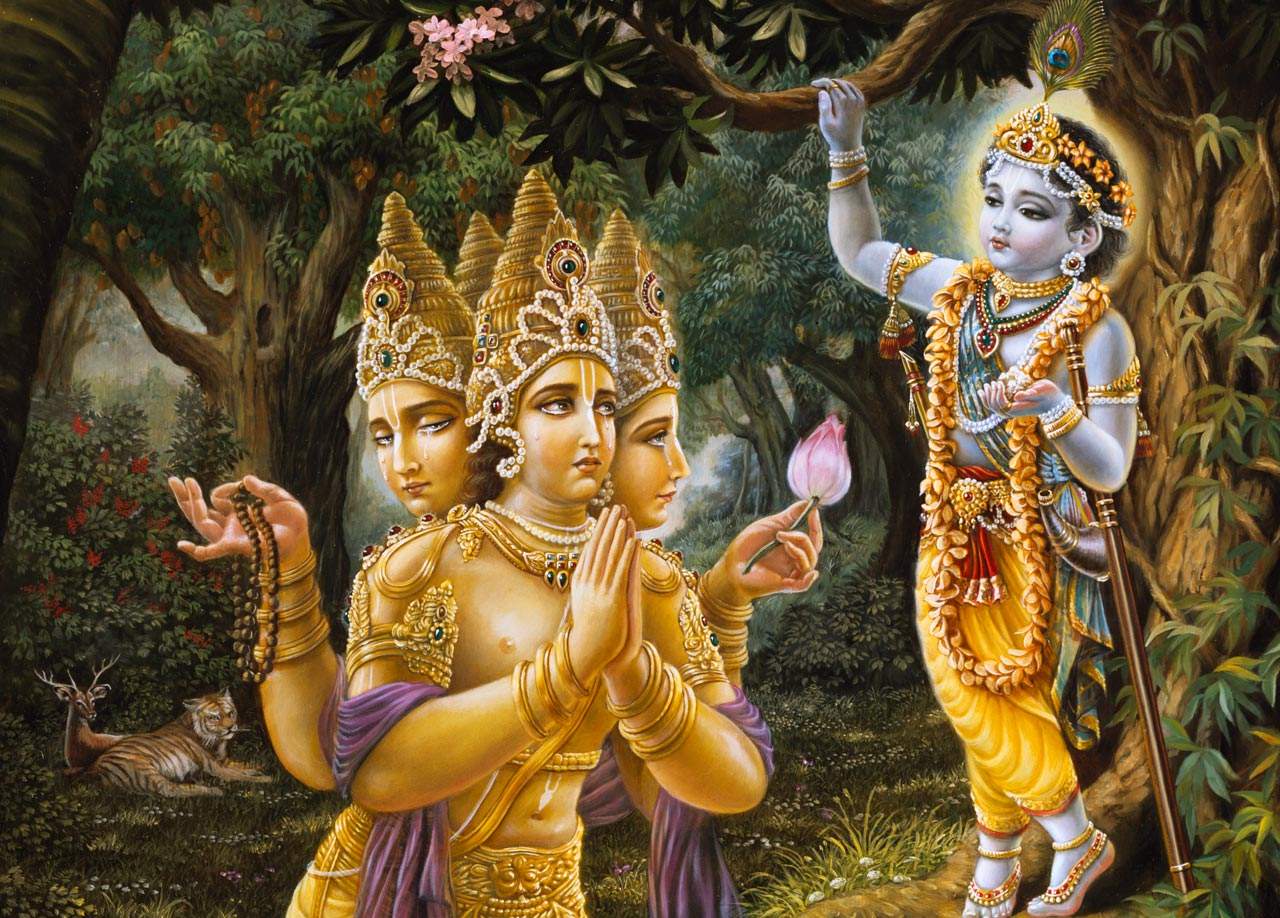
To personally witness God's pastimes and reaction means Lord Brahma was quite confused and wanted to check his mystic power, he thought to take test. One day Lord Brahma steals the boys and calves while they were all lunching with Shree Krishna and kept them all hidden and sleeping for one year...
Lord Brahma returned after a moment ( assumed as one year(per our solar calculation))to see what happened actually. Lord Brahma saw that Krishna had expanded himself and transformed into the many stolen boys and calves into Lord Visnu forms for this full one year, so that the mothers of his friends,cows are not disturbed and also to show lord Brahma the supremacy of Godhead.
Lord Brahma was so much perplexed and not able to understand the extraordinary mystic powers of Lord Krishna and then when God raised the curtain of maya Lord Brahma realized his actual position and offered his prayers to the Supreme Personality of Godhead.

Image - Lord Brahma sees Lord Vishnu

July 10, 2013
Hindu Lord Vishnu RARE BEAUTIFUL PICTURES
Know More On...
Facts about God,
Hindu God Vishnu Images,
Lord Vishnu Wallpapers,
Wallpapers
God Vishnu Image


Hindu God Vishnu Painting image

Hindu Lord Vishnu Painting

Lord Vishnu Picture on Garuda


Lord Vishnu image in Meditation Form


Image of Lord Vishnu seated on Garuda

Hindu Lord Vishnu Image

Hindu God Vishnu in shaded Image

Hindu God Vishnu Painting image

Hindu Lord Vishnu Painting

Lord Vishnu Picture on Garuda

Lord Vishnu Picture in painting

Lord Vishnu image in Meditation Form

Lord Vishnu Image riding on Garuda

Hindu Lord Vishnu Image at Sunrise

July 3, 2013
List of Hindu Gods and Goddesses
Know More On...
Facts about God,
facts about Goddess,
Facts about India,
INDIA,
List of Hindu Gods and Goddesses
Hindu Deities - Gods and Goddesses Image

About Hindu Gods and Goddesses-Hindu Deities

About Hindu Gods and Goddesses-Hindu Deities
India is the great country and one of the most religiously varied nation in the entire world. India has been playing a vital role with religion in the lives of most Indians. In India is considered as one of the oldest, most religious and idealistic systems in the world as there are 80% people who are Hindus.
The Hindu Pantheon of Gods and goddesses is so vast. In India, there are 330 millions or more Gods and Goddesses in Hindu religion. All the Hindu gods and goddesses have their own and extra ordinary images and deities to represent.
The Hindu sacred scriptures were eloquent or smooth-spoken while drawing the qualities of God and describing briefly. The all Hindu gods and goddesses are all powerful and all-knowing. They are very personification of love, beauty and justice. They are ever ready to show their mercy, grace and blessings on their creation.
Indian Hindu Gods and Goddesses picture

The main Hindu Gods as we worship and accept today can be broadly classified as
Shiva Gods -- Siva including His consort, His sons, His other forms
Vaishnava Gods -- Vishnu including His consort, His various incarnations and
Sakthi or Saktha -- Forms of Goddess Sakthi
According to the Rig Veda, we can know of the Vedic Gods
Eight Vasus,
Eleven Rudras,
Twelve Adityas,
Indra and Prajapathi,
Being the Gods of all -- the earth, the space and the heavens.
But in reality, in Rig Veda - lore of the verses, counts numerous Vedic Gods.
Vedic priests believed in rituals and ceremonies which were mostly offered to appease these all Gods. It is true that no one Vedic God or particular one God has been considered as the Supreme God.
In fact, all different Gods and goddesses have been considered as Supreme and ultimate at different times, attributing the qualities and powers of one to another.
Apart from Gods and goddesses who have been attributed specific qualities, characteristics, several inanimate objects, emotions and the various forms of nature had also been sacred and worshipped most probably.
All Hindu Gods and Goddesses Image

The earliest accepted Gods are
Dyaush-pita -- the sky father
Prithivi mata -- the earth mother
Vayu -- the wind God
Parjanya -- the rain God
Surya -- the sun God
Varuna -- the God of oceans
Agni -- the fire God
Indra -- the war God
Soma -- the God of speech, deity of soma creeper
Ushas -- the Goddess of dawn
Yama -- the God of death
Adityas -- a group of deities, who are six in number in the Rig Veda, eight in most of the Brahmanas and twelve in the Satapatha Brahmana
Aswini -- twin Deities
Rudras -- eight in number
Vasus -- eight in number
Visvedevas -- ten in number
Nakshatra -- The Constellations or stars
Space -- Antariksha
Sky -- Dyaus
*************************************************************************************
But these all Gods are classified as under
**************************************************************************************
The great and chief Hindu Gods
Hindu Trinity Gods-Tridev
The names are
God Brahma –- creator of the entire universe
God Vishnu – The preserver of the Universe
God Shiva – The destroyer and has the power of his 3rd eye
The great and chief Hindu Goddesses
Hindu Trinity Goddesses –Tridevi
The names are
Goddess Saraswati -- The consort of God Brahma, the goddess for knowledge
Goddess Laxmi –- The Consort of God Vishnu and the goddess of wealth, delight, beauty and love.
Goddess Parvati -- The consort of God Shiva and the goddess of transformation, power and destruction.
The God and Goddess incarnation
Sati Maa -- the form of Goddess Parvati
Durga Maa -- the form of Goddess Parvati and the energy of mother
Kali Mata -- having the destructive power and harmful energy
The Mahadevi -- the powerful form of Shakti
Sita Mata -- the consort of Lord Rama
Rukmani -- the consort of Lord Krishna
Radha -- the divine devotee and fan of Lord Krishna
Ganga Mata -- the holy river
Yamuna Maa -- the holy river
Gayatri Maa -- the goddess of learning
Santoshi Maa -- the goddess
Mata Vishnodevi -- the goddess
Maa Annpurna -- the goddess of Harvests
God Rama -- the seventh incarnation of God Vishnu
God Krishna -- the eighth incarnation of God Vishnu
God Bhirav -- the strong and powerful incarnation of God Shiva
The Most 10 Incarnation of God Vishnu
Matsya Avatar -- Vishnu as a fish
Kurma Avatar -- Vishnu as a tortoise
Varaha Avatar -- Vishnu as a boar
Narasimha Avatar –- Vishnu the half lion-half man)
Vamana Avatar –- Vishnu as in form of the dwarf
Parasurama Avatar –- Vishnu as brahaman’s son - Rama with an axe
Rama Avatar –- Vishnu as the prince of Ayodhya
Krishna Avatar -- Vishnu as in black tribal
Buddha Avatar –- Vishnu as form of the completely enlightened one
Kalki Avatar –- Vishnu -- the incarnation to come in future
Sons and Relatives
Ganesh -- son of God Shiva and Goddess Parvati
Kartikeya -- Subramaynan, Shanmuga -- son of Shiva and Parvati
Krishna -- son of Vasudeva and younger brother of Balarama
Balarama – Elder brother of Lord Krishna
Hanuman -- son of Vayu
Vasudeva -- The father of Lord Krishna
The Hindu Cosmic Trinity or Vedic Gods
Surya – The god of energy or life
Agni – The god of fire
Vayu – The god of air
The other Hindu Vedic or Lesser Gods
ARJUNA (the dew) : God of the dawn and the charioteer of the sun (son of Vinata and the wise Kasyapa.
Ganga- personification of the holy river
Gayatri- personification of the Vedic hymn
Hanuman- the monkey god - devotee of Rama
Indra- King of the abode of gods
Kamdeva- god of love
Kubera- god of wealth
Manu – the Hindu Noah
Narada- the wandering seer who features in almost all the Puranas
Rudra – the god of storms
Sanjna - the god of conscience and the wife of SURYA (sun)
Soma- the moon god
Varuna- the god of oceans
Vishwakarma- the divine architect of the universe
Yama- the god of death
Celestial beings
Apsaras- beautiful ladies, who dance in the court of Indra and names RAMBHA,
URVASI and MENAKA
Gandharvas- celestial musicians who play in the court of Indra
Kinnaras- mythical beings, with a body of a man and head of a horse
Siddhas- classes of spirits of great purity and holiness
Yaksha- the guardians of wealth and attendants of Kubera
In Hindu mythology, Animals have also a special place.
Main Animal Deities
SHESHNAG or ANANTA -- the infinite - the king of Nagas, vehicle of Vishnu or the
bed on which Vishnu rests
KAMADHENU --- the cow of plenty
GARUDA -- the king of birds - half man and half eagle or vulture, vehicle of Vishnu
AIRAVATA -- the elephant - vehicle of Indra
The other various Animal Deities in Hindu Mythology
AKUPARA-the tortoise - on which Earth or Prithvi rests
ANTELOPE--- vehicle of Vayu and Chandra
ARVA --- mythical being half horse and half bird - one of the horses of the moon
BUFFALO --- vehicle of Yama
CERBURA --- the three headed infernal dog of the Krishna legend
CROW --- vehicle of Shani
DOG and HORSE --- vehicle of Shiva as Bhairava
JAMBAVANT --- the king of bears - ally of Rama
MAKARA or JALAMPA --- the mythical sea monster - vehicle of Varuna (god of water)
MOUSE --- vehicle of Ganesha
NANDI --- the bull - vehicle of Shiva and Parvati
PARAVANI --- the peacock - vehicle of Kartikeya
PARROT --- vehicle of Kamadeva
RAM --- the he-goat - vehicle of Agni
SARAMA --- dog of Indra
SWAN --- vehicle of Saraswati and Brahma
TARKSHYA --- winged horse personifying the sun
TIGER and LION --- vehicle of Parvati as Kali and Durga
UCHCHAIH-SRAVAS --- the eight headed king of horses produced during the churning
of oceans
The Hindu Pantheon of Gods and goddesses is so vast. In India, there are 330 millions or more Gods and Goddesses in Hindu religion. All the Hindu gods and goddesses have their own and extra ordinary images and deities to represent.
The Hindu sacred scriptures were eloquent or smooth-spoken while drawing the qualities of God and describing briefly. The all Hindu gods and goddesses are all powerful and all-knowing. They are very personification of love, beauty and justice. They are ever ready to show their mercy, grace and blessings on their creation.
Indian Hindu Gods and Goddesses picture

The main Hindu Gods as we worship and accept today can be broadly classified as
Shiva Gods -- Siva including His consort, His sons, His other forms
Vaishnava Gods -- Vishnu including His consort, His various incarnations and
Sakthi or Saktha -- Forms of Goddess Sakthi
According to the Rig Veda, we can know of the Vedic Gods
Eight Vasus,
Eleven Rudras,
Twelve Adityas,
Indra and Prajapathi,
Being the Gods of all -- the earth, the space and the heavens.
But in reality, in Rig Veda - lore of the verses, counts numerous Vedic Gods.
Vedic priests believed in rituals and ceremonies which were mostly offered to appease these all Gods. It is true that no one Vedic God or particular one God has been considered as the Supreme God.
In fact, all different Gods and goddesses have been considered as Supreme and ultimate at different times, attributing the qualities and powers of one to another.
Apart from Gods and goddesses who have been attributed specific qualities, characteristics, several inanimate objects, emotions and the various forms of nature had also been sacred and worshipped most probably.
All Hindu Gods and Goddesses Image

The earliest accepted Gods are
Dyaush-pita -- the sky father
Prithivi mata -- the earth mother
Vayu -- the wind God
Parjanya -- the rain God
Surya -- the sun God
Varuna -- the God of oceans
Agni -- the fire God
Indra -- the war God
Soma -- the God of speech, deity of soma creeper
Ushas -- the Goddess of dawn
Yama -- the God of death
Adityas -- a group of deities, who are six in number in the Rig Veda, eight in most of the Brahmanas and twelve in the Satapatha Brahmana
Aswini -- twin Deities
Rudras -- eight in number
Vasus -- eight in number
Visvedevas -- ten in number
Nakshatra -- The Constellations or stars
Space -- Antariksha
Sky -- Dyaus
*************************************************************************************
But these all Gods are classified as under
**************************************************************************************
The great and chief Hindu Gods
Hindu Trinity Gods-Tridev
The names are
God Brahma –- creator of the entire universe
God Vishnu – The preserver of the Universe
God Shiva – The destroyer and has the power of his 3rd eye
The great and chief Hindu Goddesses
Hindu Trinity Goddesses –Tridevi
The names are
Goddess Saraswati -- The consort of God Brahma, the goddess for knowledge
Goddess Laxmi –- The Consort of God Vishnu and the goddess of wealth, delight, beauty and love.
Goddess Parvati -- The consort of God Shiva and the goddess of transformation, power and destruction.
The God and Goddess incarnation
Sati Maa -- the form of Goddess Parvati
Durga Maa -- the form of Goddess Parvati and the energy of mother
Kali Mata -- having the destructive power and harmful energy
The Mahadevi -- the powerful form of Shakti
Sita Mata -- the consort of Lord Rama
Rukmani -- the consort of Lord Krishna
Radha -- the divine devotee and fan of Lord Krishna
Ganga Mata -- the holy river
Yamuna Maa -- the holy river
Gayatri Maa -- the goddess of learning
Santoshi Maa -- the goddess
Mata Vishnodevi -- the goddess
Maa Annpurna -- the goddess of Harvests
God Rama -- the seventh incarnation of God Vishnu
God Krishna -- the eighth incarnation of God Vishnu
God Bhirav -- the strong and powerful incarnation of God Shiva
The Most 10 Incarnation of God Vishnu
Matsya Avatar -- Vishnu as a fish
Kurma Avatar -- Vishnu as a tortoise
Varaha Avatar -- Vishnu as a boar
Narasimha Avatar –- Vishnu the half lion-half man)
Vamana Avatar –- Vishnu as in form of the dwarf
Parasurama Avatar –- Vishnu as brahaman’s son - Rama with an axe
Rama Avatar –- Vishnu as the prince of Ayodhya
Krishna Avatar -- Vishnu as in black tribal
Buddha Avatar –- Vishnu as form of the completely enlightened one
Kalki Avatar –- Vishnu -- the incarnation to come in future
Sons and Relatives
Ganesh -- son of God Shiva and Goddess Parvati
Kartikeya -- Subramaynan, Shanmuga -- son of Shiva and Parvati
Krishna -- son of Vasudeva and younger brother of Balarama
Balarama – Elder brother of Lord Krishna
Hanuman -- son of Vayu
Vasudeva -- The father of Lord Krishna
The Hindu Cosmic Trinity or Vedic Gods
Surya – The god of energy or life
Agni – The god of fire
Vayu – The god of air
The other Hindu Vedic or Lesser Gods
ARJUNA (the dew) : God of the dawn and the charioteer of the sun (son of Vinata and the wise Kasyapa.
Ganga- personification of the holy river
Gayatri- personification of the Vedic hymn
Hanuman- the monkey god - devotee of Rama
Indra- King of the abode of gods
Kamdeva- god of love
Kubera- god of wealth
Manu – the Hindu Noah
Narada- the wandering seer who features in almost all the Puranas
Rudra – the god of storms
Sanjna - the god of conscience and the wife of SURYA (sun)
Soma- the moon god
Varuna- the god of oceans
Vishwakarma- the divine architect of the universe
Yama- the god of death
Celestial beings
Apsaras- beautiful ladies, who dance in the court of Indra and names RAMBHA,
URVASI and MENAKA
Gandharvas- celestial musicians who play in the court of Indra
Kinnaras- mythical beings, with a body of a man and head of a horse
Siddhas- classes of spirits of great purity and holiness
Yaksha- the guardians of wealth and attendants of Kubera
In Hindu mythology, Animals have also a special place.
Main Animal Deities
SHESHNAG or ANANTA -- the infinite - the king of Nagas, vehicle of Vishnu or the
bed on which Vishnu rests
KAMADHENU --- the cow of plenty
GARUDA -- the king of birds - half man and half eagle or vulture, vehicle of Vishnu
AIRAVATA -- the elephant - vehicle of Indra
The other various Animal Deities in Hindu Mythology
AKUPARA-the tortoise - on which Earth or Prithvi rests
ANTELOPE--- vehicle of Vayu and Chandra
ARVA --- mythical being half horse and half bird - one of the horses of the moon
BUFFALO --- vehicle of Yama
CERBURA --- the three headed infernal dog of the Krishna legend
CROW --- vehicle of Shani
DOG and HORSE --- vehicle of Shiva as Bhairava
JAMBAVANT --- the king of bears - ally of Rama
MAKARA or JALAMPA --- the mythical sea monster - vehicle of Varuna (god of water)
MOUSE --- vehicle of Ganesha
NANDI --- the bull - vehicle of Shiva and Parvati
PARAVANI --- the peacock - vehicle of Kartikeya
PARROT --- vehicle of Kamadeva
RAM --- the he-goat - vehicle of Agni
SARAMA --- dog of Indra
SWAN --- vehicle of Saraswati and Brahma
TARKSHYA --- winged horse personifying the sun
TIGER and LION --- vehicle of Parvati as Kali and Durga
UCHCHAIH-SRAVAS --- the eight headed king of horses produced during the churning
of oceans
It is less to describe about the list of Hindu Gods Goddesses but here most of all has been covered.
May 8, 2013
Tenth Incarnation Vishnu-Kalki Avtar
Know More On...
AVATARS -DASAVATAR,
Facts about God,
Tenth Incarnation Vishnu-Kalki Avtar
Kalki Avtar

Story of Kalki Avtar
The KALKI Avatar is the tenth, last and great incarnation of Lord Vishnu. The Lord Vishnu will be emerged as Kalki incarnation. Yet this incarnation is not appeared on the universe but it is expected that lord Vishnu will incarnate at the end of Kali yuga. The period which is currently exist, is Kali Yuga and will be ended when lord Vishnu will incarnate as Kalki and destroy the foulness.
In KALKI Avatar, Vishnu will be in the form of KALKI, the powerful machine-man with extra ordinary strength and will be looked as awesome man who will come in the pose of riding on his white horse with his blazing sword in his hands.
This all things are supposed that to be happened in a future means at the end of "Kali Yuga-present eon" incarnation of Lord Vishnu. As Lord Vishnu is the preserver, he will incarnate himself in a form of Kalki, destroy the evil spirits punishing them and again re-establish the golden age with the Dharma, order, truth and law.
- Tenth Incarnation Vishnu-Kalki Avtar
- Nineth Incarnation Vishnu-Buddha Avtar
- Eighth Incarnation Vishnu-Krishna Avtar
- Seventh Incarnation Vishnu-Rama Avtar
- Sixth Incarnation Vishnu-Parshuram Avtar
- Fifth Incarnation Vishnu-Vamana Avtar
- Forth Incarnation Vishnu-Narsimha Avtar
- Third Incarnation Vishnu-Varaha Avatar
- Second Incarnation Vishnu-Kurma Avtar
- First Incarnation-Vishnu-Matsya Avtar
Nineth Incarnation Vishnu-Buddha Avtar
Know More On...
AVATARS -DASAVATAR,
Facts about God,
Nineth Incarnation Vishnu-Buddha Avtar
Buddha Avtar
 Story of Buddha Avtar

The BUDDHA ( Mahavir Buddha ) Avatar, the ninth incarnation of Lord Vishnu who emerged as BUDDHA in the Kali Yuga. ''Buddha'' means 'the enlightened one' and he proved his name. He was the great abstainer in a form of prince who abdicated the coronation to lead the universe on the path of peace and became the founder of the BUDDHIST religion that well-known across the globe.
He was son of Suddhodana and Maya, born the crown prince of the Kapilavastu. He was named as “Siddhartha” means "All things fulfilled" by the king. After his birth in very short time his mother died. Fortunately Prajapati-the sister of Maya brought Siddhartha up.
Buddha was saddened by death of living creatures, since his days of childhood. He used to question: "Alas! Do all living creatures kill each other?" He wasn't satisfied with any answers that were given to him and he decided to find out the meaning and the absolute truth.
He taught and observed that all sorrow comes from attachments and desires, so it's better to curb all attachments in order to remain happy.
Lord Buddha is considered as a noble and a divine incarnation (avatar) of Lord Vishnu in assured sects of Hinduism.
He was son of Suddhodana and Maya, born the crown prince of the Kapilavastu. He was named as “Siddhartha” means "All things fulfilled" by the king. After his birth in very short time his mother died. Fortunately Prajapati-the sister of Maya brought Siddhartha up.
Buddha was saddened by death of living creatures, since his days of childhood. He used to question: "Alas! Do all living creatures kill each other?" He wasn't satisfied with any answers that were given to him and he decided to find out the meaning and the absolute truth.
He taught and observed that all sorrow comes from attachments and desires, so it's better to curb all attachments in order to remain happy.
So one day he left his wife and child and decided to live as a hermit's life and went away in the forest and became the enlightened one. His sermoning spawned off the religion of Buddhism now admired across the whole world.
Lord Buddha is considered as a noble and a divine incarnation (avatar) of Lord Vishnu in assured sects of Hinduism.
- Tenth Incarnation Vishnu-Kalki Avtar
- Nineth Incarnation Vishnu-Buddha Avtar
- Eighth Incarnation Vishnu-Krishna Avtar
- Seventh Incarnation Vishnu-Rama Avtar
- Sixth Incarnation Vishnu-Parshuram Avtar
- Fifth Incarnation Vishnu-Vamana Avtar
- Forth Incarnation Vishnu-Narsimha Avtar
- Third Incarnation Vishnu-Varaha Avatar
- Second Incarnation Vishnu-Kurma Avtar
- First Incarnation-Vishnu-Matsya Avtar
Eighth Incarnation Vishnu-Krishna Avtar
Know More On...
AVATARS -DASAVATAR,
Eighth Incarnation Vishnu-Krishna Avtar,
Facts about God
Krishna Avtar

The Story of KRISHNA Avatar
KRISHNA Avatar, is the eighth incarnation Lord Vishnu with his brother “Balarama” in the form of cowherd as KRISHNA who had played a vital role as a central character in the epic MAHABHARATA in the era of “Dwaparyuga”. In the major epic of Indian legends a countless of topics are covered, including brotherhood, love, war, politics etc.
It is basically the story of two warring groups of cousin brothers, the PANDAVAs and the KAURAVAs. During the war, as a main part of the Mahabahrata, KRISHNA gives a long discussion to his disciple ARJUNA that communally termed as “Bhagvad-Gita” in that he repeated his words again as he is a preserver of the Universe.
He said,
“Whenever Dharma, the situation of law and order is endangered on this world, I incarnate onto this world to re establish Dharma, truth, law and order; protect the Sadhus, sages or saints and destroy the evil elements of the earth.”
During his child-hood, Krishna became a slayer of King Kansa. As Krishna was so charm, he captivated to all by playing flute including Gopikaas that’s why he is considered to be an ultimate Playboy but he spread the message of love and humankind. Lord Krishna, the perfect incarnation of Lord Vishnu also famed as "Shyam" according his names meaning: Krishna-black as well as charming (attractive).
This was differ than Ramayan as Mahabharata conducts with more, down to the earth issues such as human weaknesses, politics, human nature and moreover does not effort to idealize the noble characters as in Ramayan.
Lord Krishna is the most worshiped deity and great incarnation of Lord Vishnu.

The Story of KRISHNA Avatar
KRISHNA Avatar, is the eighth incarnation Lord Vishnu with his brother “Balarama” in the form of cowherd as KRISHNA who had played a vital role as a central character in the epic MAHABHARATA in the era of “Dwaparyuga”. In the major epic of Indian legends a countless of topics are covered, including brotherhood, love, war, politics etc.
It is basically the story of two warring groups of cousin brothers, the PANDAVAs and the KAURAVAs. During the war, as a main part of the Mahabahrata, KRISHNA gives a long discussion to his disciple ARJUNA that communally termed as “Bhagvad-Gita” in that he repeated his words again as he is a preserver of the Universe.
He said,
“Whenever Dharma, the situation of law and order is endangered on this world, I incarnate onto this world to re establish Dharma, truth, law and order; protect the Sadhus, sages or saints and destroy the evil elements of the earth.”
During his child-hood, Krishna became a slayer of King Kansa. As Krishna was so charm, he captivated to all by playing flute including Gopikaas that’s why he is considered to be an ultimate Playboy but he spread the message of love and humankind. Lord Krishna, the perfect incarnation of Lord Vishnu also famed as "Shyam" according his names meaning: Krishna-black as well as charming (attractive).
This was differ than Ramayan as Mahabharata conducts with more, down to the earth issues such as human weaknesses, politics, human nature and moreover does not effort to idealize the noble characters as in Ramayan.
Lord Krishna is the most worshiped deity and great incarnation of Lord Vishnu.
Seventh Incarnation Vishnu-Rama Avtar
Know More On...
AVATARS -DASAVATAR,
Facts about God,
Seventh Incarnation Vishnu-Rama Avtar
Rama Avtar

Story of Rama Avtar

Story of Rama Avtar
Rama incarnation, the seventh incarnation of Lord Vishnu who incarnated in a form of a great ideal King. He played a vital role as a main character in the epic Ramayana in the era of Tretayuga. The main purpose of this incarnation was to present the ideal character in every role such as an ideal person, an ideal son, an ideal husband, an ideal king.
Rama, the prince of Ayodhya, was the son of great king Dashrath and queen Kaushalya. Lord Vishnu was incarnated himself as RAMA to destroy the all demons (asura) main the King of Lanka (presently known as Shree Lanka)named Ravana-with ten head who had blessed with a boon from Brahma and also from some other celestial beings. Ravana had so proud of his power and illusion that no body can kill him and he was vainglorious by nature and wished to be vanquished or won by man.
In Tretayuga Lord Vishnu was in form of Rama and his consort (wife) Goddess Laxmi in form of Sita. In Ramayana, the story of war between a Demon Ravana and Lord RAMA is so exciting. Rama was banished by his step mother to a forest so he went away with her wife Sita and brother Laxmana. As Ravana snatched Sita, Rama released her with Hanuman-his loyal devotee and Laxman-his brother by a war. By this war he removed all evil elements from the Universe including the main Demon RAVANA.
In Ramayana, the role of Shree Rama epitomises the ideal behavior of man. In this incarnation he focused on the relation of man-wife, son-father, son-mother, brother-brother, master-loyal sevak (servant) and main relationship between king-people (Raja-praja) with his rules for ideal governance as a king.
Lord Rama is one of the most famous gods in the Hindu religion as he was the mythical, fabulous and real King in the ancient India. He has given the message of equality, Hindu devotion and mainly the rules of Dharma.
Lord Vishnu's incarnation as Rama was really in ideal form.
Rama, the prince of Ayodhya, was the son of great king Dashrath and queen Kaushalya. Lord Vishnu was incarnated himself as RAMA to destroy the all demons (asura) main the King of Lanka (presently known as Shree Lanka)named Ravana-with ten head who had blessed with a boon from Brahma and also from some other celestial beings. Ravana had so proud of his power and illusion that no body can kill him and he was vainglorious by nature and wished to be vanquished or won by man.
In Tretayuga Lord Vishnu was in form of Rama and his consort (wife) Goddess Laxmi in form of Sita. In Ramayana, the story of war between a Demon Ravana and Lord RAMA is so exciting. Rama was banished by his step mother to a forest so he went away with her wife Sita and brother Laxmana. As Ravana snatched Sita, Rama released her with Hanuman-his loyal devotee and Laxman-his brother by a war. By this war he removed all evil elements from the Universe including the main Demon RAVANA.
In Ramayana, the role of Shree Rama epitomises the ideal behavior of man. In this incarnation he focused on the relation of man-wife, son-father, son-mother, brother-brother, master-loyal sevak (servant) and main relationship between king-people (Raja-praja) with his rules for ideal governance as a king.
Lord Rama is one of the most famous gods in the Hindu religion as he was the mythical, fabulous and real King in the ancient India. He has given the message of equality, Hindu devotion and mainly the rules of Dharma.
Lord Vishnu's incarnation as Rama was really in ideal form.
Sixth Incarnation Vishnu-Parshuram Avtar
Know More On...
AVATARS -DASAVATAR,
Facts about God,
Sixth Incarnation Vishnu-Parshuram Avtar
Parshuram Avtar

Story of Parshuram Avtar

Story of Parshuram Avtar
PARASHURAMA Avatar, the sixth incarnation of Lord Vishnu who incarnates himself as an angry brahmana or priest in the world.
PARASHURAMA was emerged in the universe for the exceptional purpose regarding to brahmans and kshatriyas. In Tretayuga, all kshatriyas had become very arrogant and were repressing the all brahmans, therefore he strong-willed to revenge and protect the all brahmans from Kshatriyas in the universe.
PARASHURAMA who was a son of saint Jamadagni and Renuka, belonged to the Brighu clan (gotra). He was a fervent devotee of Lord Shiva from whom he blessed with an axe after his strong penance (devotion) therefore Parashurama preferred to preserve an axe presented by Lord Shiva. Parashurama is immortal ( Chiranjeevi ).
One day when PARASHURAMA was not at home, Kartavirya-arjuna who was a powerful king, visited to Jamadagni's home with his army once. Saint Jamadagni welcomed them with loyal heart and fed them all by offering milk and foods through his divine cow-Kamadhenu and the King was satisfied with the meal. Jamadagni's cow-Kamadhenu was really almighty as it had the capability to provide endless food according to the desire.
When King Kartavirya-arjuna saw this miracle, he surprised and thought about to bring that cow into his palace. So he demanded to saint Jamadagni to take Kamdhenu with him but Saint Jamadagni refused as Kamdhenu was needed to him in his all religious ceremonies. The king got angry and ordered his soldiers to snatch Kamadhenu cow which was supposed to give eternal quantity of milk and food.
Jamadagni was enraged as king’s soldiers took away Kamadhenu, therefore he brought Kamadhenu back by killing the King. When King’s son came to know this, he turned to Jamadagni’s home and killed him. On hearing this all things, Parashurama was much angered and went for revenge of his father’s death and killed the whole clan of Kartavirya-arjuna and all kshatriyas in 21 battles.
Parashurama who destroyed all the kings and got release all brahamans from suppression of kings, was really a great worrier and solid incarnation of Lord Vishnu.
PARASHURAMA was emerged in the universe for the exceptional purpose regarding to brahmans and kshatriyas. In Tretayuga, all kshatriyas had become very arrogant and were repressing the all brahmans, therefore he strong-willed to revenge and protect the all brahmans from Kshatriyas in the universe.
PARASHURAMA who was a son of saint Jamadagni and Renuka, belonged to the Brighu clan (gotra). He was a fervent devotee of Lord Shiva from whom he blessed with an axe after his strong penance (devotion) therefore Parashurama preferred to preserve an axe presented by Lord Shiva. Parashurama is immortal ( Chiranjeevi ).
One day when PARASHURAMA was not at home, Kartavirya-arjuna who was a powerful king, visited to Jamadagni's home with his army once. Saint Jamadagni welcomed them with loyal heart and fed them all by offering milk and foods through his divine cow-Kamadhenu and the King was satisfied with the meal. Jamadagni's cow-Kamadhenu was really almighty as it had the capability to provide endless food according to the desire.
When King Kartavirya-arjuna saw this miracle, he surprised and thought about to bring that cow into his palace. So he demanded to saint Jamadagni to take Kamdhenu with him but Saint Jamadagni refused as Kamdhenu was needed to him in his all religious ceremonies. The king got angry and ordered his soldiers to snatch Kamadhenu cow which was supposed to give eternal quantity of milk and food.
Jamadagni was enraged as king’s soldiers took away Kamadhenu, therefore he brought Kamadhenu back by killing the King. When King’s son came to know this, he turned to Jamadagni’s home and killed him. On hearing this all things, Parashurama was much angered and went for revenge of his father’s death and killed the whole clan of Kartavirya-arjuna and all kshatriyas in 21 battles.
Parashurama who destroyed all the kings and got release all brahamans from suppression of kings, was really a great worrier and solid incarnation of Lord Vishnu.
Fifth Incarnation Vishnu-Vamana Avtar
Know More On...
AVATARS -DASAVATAR,
Facts about God,
Fifth Incarnation Vishnu-Vamana Avtar
Vamana Avtar

Story of Vamana Avtar
VAMANA Avatar, the fifth incarnation of Lord Vishnu who emerged in a form of Dwarf priest ( Vaman-brahmin ) in the world and also known as Upendra.
In Tretayuga, a brave ruler named Bali who was so powerful demon was the grandson of Prahlada. King Bali was not only a valorous (bold) but also mightily demon (asura). King Bali had conquered the entire universe by his self-penance and power.
King Bali was the great ruler of the universe ( three worlds ) and inclined to continue his domination. Bali attempted to cement his image and place as a ruler; he conducted a grand ceremony in a series of yajnas ( sacrifice or prayer ).
Lord Indra and other gods feared about this as it would happen then King Bali and all demons (asuras) would conquer the entire universe means all the three worlds. Therefore he went to Lord Vishnu and requested to assist them.
As Lord Vishnu is the preserver of the universe, to get the rid from this trouble he incarnated himself as a Dwarf (Vamana) in the household of a priest (brahmana). He went to Bali’s place where he was performing his last yajna and asked for alms.
Though Bali was little confused about his look but was so delighted for the presence of such a saintly being. King said Vamana that anything for alms would be offered and fulfilled whatever he wished. Though his priest warned him that he was Lord Vishnu in that form and also got aware about the tangle of Lord Vishnu but he didn’t move a little from his offer.
Vamana then asked for the quantity of land about his three feet only. First Bali laughed for his proposal but then agreed gracefully. Asuraguru Sukracharya got angered and again warned King Bali that Vamana was MahaVishnu in reality and he came again to defeat all demons (asuras) in race but King invoked his and agreed for Vaman’s alms.
In no time, God Vishnu grew in size and covered the entire earth in one feet and heaven in two feet (strides). And then asked about where he covered his third feet. King Bali assured him for alms whatever his desire therefore due to the lack of space and in order to keep his promise, he offered his head for third feet. Then Vamana put his third leg on Bali’s head and defeated him totally and this way Lord Vishnu helped the Gods out.
Vamana pleased by his strong determination and keeping his promise and then took his actual form of Lord Vishnu. Lord Vishnu named him as “King Mahabali” as he was great soul (Mahatma). Lord Vishnu ordered him to go back to the spiritual sky (means the Patal loka or underground world) and declared that King Mahabali would rule over the Universe in subsequent Yuga.
The fifth incarnation of Lord Vishnu as a Dwarf (Vamana) was really great.

Story of Vamana Avtar
VAMANA Avatar, the fifth incarnation of Lord Vishnu who emerged in a form of Dwarf priest ( Vaman-brahmin ) in the world and also known as Upendra.
In Tretayuga, a brave ruler named Bali who was so powerful demon was the grandson of Prahlada. King Bali was not only a valorous (bold) but also mightily demon (asura). King Bali had conquered the entire universe by his self-penance and power.
King Bali was the great ruler of the universe ( three worlds ) and inclined to continue his domination. Bali attempted to cement his image and place as a ruler; he conducted a grand ceremony in a series of yajnas ( sacrifice or prayer ).
Lord Indra and other gods feared about this as it would happen then King Bali and all demons (asuras) would conquer the entire universe means all the three worlds. Therefore he went to Lord Vishnu and requested to assist them.
As Lord Vishnu is the preserver of the universe, to get the rid from this trouble he incarnated himself as a Dwarf (Vamana) in the household of a priest (brahmana). He went to Bali’s place where he was performing his last yajna and asked for alms.
Though Bali was little confused about his look but was so delighted for the presence of such a saintly being. King said Vamana that anything for alms would be offered and fulfilled whatever he wished. Though his priest warned him that he was Lord Vishnu in that form and also got aware about the tangle of Lord Vishnu but he didn’t move a little from his offer.
Vamana then asked for the quantity of land about his three feet only. First Bali laughed for his proposal but then agreed gracefully. Asuraguru Sukracharya got angered and again warned King Bali that Vamana was MahaVishnu in reality and he came again to defeat all demons (asuras) in race but King invoked his and agreed for Vaman’s alms.
In no time, God Vishnu grew in size and covered the entire earth in one feet and heaven in two feet (strides). And then asked about where he covered his third feet. King Bali assured him for alms whatever his desire therefore due to the lack of space and in order to keep his promise, he offered his head for third feet. Then Vamana put his third leg on Bali’s head and defeated him totally and this way Lord Vishnu helped the Gods out.
Vamana pleased by his strong determination and keeping his promise and then took his actual form of Lord Vishnu. Lord Vishnu named him as “King Mahabali” as he was great soul (Mahatma). Lord Vishnu ordered him to go back to the spiritual sky (means the Patal loka or underground world) and declared that King Mahabali would rule over the Universe in subsequent Yuga.
The fifth incarnation of Lord Vishnu as a Dwarf (Vamana) was really great.
- Tenth Incarnation Vishnu-Kalki Avtar
- Nineth Incarnation Vishnu-Buddha Avtar
- Eighth Incarnation Vishnu-Krishna Avtar
- Seventh Incarnation Vishnu-Rama Avtar
- Sixth Incarnation Vishnu-Parshuram Avtar
- Fifth Incarnation Vishnu-Vamana Avtar
- Forth Incarnation Vishnu-Narsimha Avtar
- Third Incarnation Vishnu-Varaha Avatar
- Second Incarnation Vishnu-Kurma Avtar
- First Incarnation-Vishnu-Matsya Avtar
Subscribe to:
Posts (Atom)
Thanks and Vist us Again
Gsv Pics |Gsv Vids |
Techno zip| Divine Thought |
For The Sake of Us | Gsv Films | DMCA POLICY
| Privacy Policy
Note: ALL THE PHOTOS,STILLS AND PICTURES FOUND IN THIS BLOG ARE FROM VARIOUS INTERNET SOURCES AND SOME ARE FROM THE PROPER RIGHT FROM THE WEBSITE OWNERS IF YOU FIND ANYTHING ILLEGAL AND YOU WANT US TO REMOVE IT FROM THIS BLOG EMAIL US TO gsvfilmsblog @ Gmail .com WE WILL REMOVE It IMMEDIATELY.... Contact Us Copyright 2011 A product of GSV Films. Actors Actress Unseen Photos!
