March 8, 2018

Importance of Kukke Subramanya

Lapped in the luxurious abundance of the beauty of the nature the village of Subramanya lies in the Sullia Taluk in Dakshina Kannada with a sancity which very few places can boast of. The temple is situated in the heart of the village. Nature reveals herself in all her unhidden beauty in the rivers, forests and mountains which the temples is surrounded by. It is about a 105 KM from Mangalore and can be easily reached by train,buses or taxis. 


Subramanya used to be called as Kukke Pattana in the past. In the 'Shankara Vijaya' Anandagiri observes that Sri Shankaracharya camped here for a few days during his religious expedition (Digvijaya). Shankaracharya referred to this place as 'Bhaje Kukke Lingam' in his 'Subrahmanya Bhujangaprayata Stotram'.

Sri Subrahmanya kshetra has been brilliantly described in the 'Thirthakshetra Mahimanipurana' chapter of the Sahyadrikhanda comprised in the Sanatkumara Samhita of Skanda Purana. This kshetra is situated in the banks of the river 'Dhara' which originates in the Kumara mountain and proceeds to the western sea.


Don't Miss to Visit   Admins Youtube Video Page

May 13, 2015

Markandeshwar,Lord Shiva Temple- Maharashtra


Markandeshwar,Lord Shiva Temple- Maharashtra

Shiv Temple Situated 40 km from Gadchiroli city is the ancient temple of Markandeshwar at Markanda in gadchiroli District of Maharashtra State, India. The village is situated on the bank of Vainganga River. The temple is believed to be extremely holy and though not a well known sight, flocked to by locals and tourists from within the state who believe in the power of the deity residing in the temple.

The outside of the temple is architecturally different from the other temples as it belongs to a different ear. But the intricate carvings have been preserved to day. Some of the carvings include sexual imagery which some say is the work of demons as the temple is said to have been mysteriously constructed within one night.
Markandeshwar Temple

This temple was supposed to be built by the Danvas (Evil forces) in one night. The temple is made of stone and the structure type is called as Hemadpanth. The Markanda temple is contructed on the bank of Vainganga in the east side in 196 x 168 Sqft. area. Earlier, there were 24 temples. At present, there are only 18 temples existing, out of them only 4 temples are in good condition. The main temple of Markanda was distracted by striking of Lightening 300 years before. Therefore, no one could tell how the main temple formerly was.

 Surrounding of the fortifications of the group temples there is temple of Dashavtar. There are 12 Pithas, there are shown extra 2 Pithas here. One of the experts of culture opinioned that these extra 2 Pithas influences the minds of the people more during this period and so more of the 2 Pithas might have been constructed. There are 12 Shivlingas in the temple and courtyard of the temple. Would this thread worn Shivlinga be called a Jyotirlinga ? Various Arts and Sculptures found in the Markanda Temple are worth a look.

Don't Miss to Visit   Admins Youtube Video Page

May 11, 2015

Konark Sun Temple - One must visit in a Life Time.

. Sun Temple, Konark


The Sun Temples of Konark are one of the most famous Sun Temples of India. Dedicated to the Sun God, the temple was created in the early 13th century and is also called by the name 'Black Pagoda'. Konark Sun Temple is in the form of a giant chariot and the stone wheels, pillars, walls are all exquisitely and intricately carved. Unfortunately, most of the carvings are now in ruins due to natural calamities and foreign invasions. 

The temple is known for 'Maithunas' which are the erotic sculptures on the temple walls. Britishers have called the Konark Temple 'most beautiful and yet the most obscene'. However, the erotic sculptures on the Sun Temple are explained by archaeologists, especially by A.K. Coomaraswamy, stating that the sculptures are a depiction of Indian sex-symbolism which is ‘sacramental’ in its likeness to the union of the individual soul with the universal spirit. The sculptures are a part of Samsara which the human must ultimately give up to reach within, on the path of Moksha.

Konark Sun Temple. 


Don't Miss to Visit   Admins Youtube Video Page

April 18, 2015

Sun Temple,Giant chariot and the stone wheels, pillars, Konark

Sun Temple, Konark

The Sun Temples of Konark are one of the most famous Sun Temples of India. Dedicated to the Sun God, the temple was created in the early 13th century and is also called by the name 'Black Pagoda'. Konark Sun Temple is in the form of a giant chariot and the stone wheels, pillars, walls are all exquisitely and intricately carved. Unfortunately, most of the carvings are now in ruins due to natural calamities and foreign invasions.

The temple is known for 'Maithunas' which are the erotic sculptures on the temple walls. Britishers have called the Konark Temple 'most beautiful and yet the most obscene'. However, the erotic sculptures on the Sun Temple are explained by archaeologists, especially by A.K. Coomaraswamy, stating that the sculptures are a depiction of Indian sex-symbolism which is ‘sacramental’ in its likeness to the union of the individual soul with the universal spirit. The sculptures are a part of Samsara which the human must ultimately give up to reach within, on the path of Moksha.

Konark Sun Temple

Mayadevi Temple
To the west of the primary temple are the remains of temple no.2 prominently called the temple of Mayadevi, accepted to have been one of the wives of Lord Surya. But the existence of the sun pictures as parsvadevata in-situ show its devotion to the sun god, build earlier than the principle Sun temple. The temple facing east, comprises of a sanctum (deul) and a porch (Jagamohana) standing over a raised stage, façade of which is relieved with ornamentation. The superstructures of the sanctum and porch are missing. The interior of the porch is famous for their sculptural treatment while the sanctum is without any deity. Elaborately, the temple is assignable to around late eleventh century AD.
Vaishnava Temple
The small brick temple facing east in south-west corner of the compound was found in 1956 while the sand clearance. Also called temple no.3 is pancharatha on plan. It comprises of a deul and a Jagamohana however with the superstructure is missing and exterior decoration. Pictures of Balarama and two parsvadevatas of Varaha and Trivikrama were uncovered (now showed in Archeological Museum, Konark) demonstrating its Vaishnava association. The temple is datable to around eleventh century A.D.
History
In 1559, Mukunda Gajapati came to throne in Cuttack. He adjusted himself as an associate of Akbar and a foe of the Sultan of Bengal, Sulaiman Khan Karrani. After a couple of fights, Odisha at last fell. The fall was additionally helped by the inward turmoil of the state. In 1568, the Konark temple was said harmed by the armed force of Kalapahad, a general of the Sultan. Kalapahad is additionally said to be in charge of harms to a few different temples throughout the victory.
As described in Bhavishya Purana and Samba Purana, there may have been a sun temple in the region earlier than current one, dating to the nineteenth century or prior. The books mention three sun temples at Mundira (perhaps Konark), Kalapriya (Mathura), and Multan.
According to the scriptures, Samba, the child of Krishna, was cursed with leprosy. He was guided by the sage, Kataka, to worship the sun god to cure his sustenance. Samba did penance for a long time 12 years in Mitravana close to the shores of Chandrabhaga. Both the real Konark temple and the Multan temple have been credited to Samba.
Near by traveler spots
  • Chandrabhaga 3.5 km From Konark Temple
  • Ramachandi 8 km From Konark Temple
  • Bhagabati Temple, Konark 2 km From Konark Temple
  • Kuruma 6 km From Konark Temple
  • Puri 35 km From Konark Temple
  • Beleswar
  • Chilika 70 km From Konark Temple
  • Bhubaneswar
  • Gopalpur Beach
  • Kenduli Sasan
Tags: konark sun mandir, konark sun temple photos, konark sun temple wallpaper. Download free konark sun temple wallpaper to adorn your computer desktop screen. konark sun temple wallpaper photos, konark sun temple wallpaper images
- See more at: http://www.maadurgawallpaper.com/konark-sun-temple#sthash.GbTOBhhP.dpuf

Don't Miss to Visit   Admins Youtube Video Page

Khajuraho - Temple Of Love- Madhya Pradesh

Khajuraho - Temple Of Love- Madhya Pradesh


1. We Indians even have a god for sex - Kama. So it is only natural that we have erotic sculptures on our temples. There have been many questions raised on the reason behind having erotic sculptures and sexual imagery in a place otherwise considered so 'holy' and 'pure'. There are a few theories floating about but the most popular one seems to be that in order to enter a place so pure, you need to relieve yourself of all your desires and lust. It is by acceptance of lust and desire in you that you can learn to control it. Furthermore, these sculptures are always on the outer walls of temples meaning that the humans need to leave their desires outside before stepping in. In many Indian manuscripts, sex was considered to be spiritual and not hedonistic. There are many such theories but the fact remains that these temples are known more for their erotic sculptures than the deities residing inside.


The Khajuraho temples are located within the "Golden Triangle" of northern India. This is the tourist route that most vacation itineraries in this part of the country follow. New Delhi, Agra, and Jaipur mark the rough outline of this triangle, and most vacation itineraries follow it for ten to fourteen days by motorcoach and/or short flights visiting the sites in those cities and along the way.

This Golden Triangle area and these three cities contain some of the greatest monuments, palaces, and forts of the mighty Mughal Empire—including the temples of Khajuraho and even the Hindu holy city of Varanasi set on the sacred Ganges River, which is a bit to the east of the triangle.
An itinerary that takes in all these sights really needs the full ten days to two weeks to give it full justice. However, the temples of Khajuraho represent one of the most visited sites in the country. The little village of Khajuraho has a modern airport, and it is possible for those who have less time to see the Taj Mahal images in Agra and enjoy a Khajuraho temple tour from New Delhi all in a single day.
The most famous of the lot, Khajuraho temples are located in Madhya Pradesh in the small town of Khajuraho which they are named after. It is not just one temple but a group of temples. It is rumoured that Shiva and other deities visited the region during ancient times to play and hence, the temples were created in their honour. All Khajuraho temples, except one, face the east and the architecture of the temples is designed in a way that is a perfect integration of male and female deities and symbols. The artwork outside the temple, that is found to be the most interesting by tourists, is a depiction of the four goals of Hinduism - Dharma, Artha, Kama and Moksha. Hence, all the erotic imagery that has so enthralled tourists.

Don't Miss to Visit   Admins Youtube Video Page

March 20, 2015

UGADI WISHES - HAPPY NEW YEAR


Happy Ugadi Images Wishes Quotes SMS in Telugu Hindi Tamil Marathi: Ugadi is also known as New Year Day for the people of the Deccan region of India. This festival is celebrated mostly at Andhra Pradesh and Karnataka. We have large collection of Ugadi messages that can be sent in different ways including SMS Messaging, Beautiful and meaning full Quotes. 

Along with enjoy you can send Happy Ugadi SMS, Messages to your friends and family members. This year, we will celebrate it on 21st March 2015 and therefore all people are excited for it. On this occasion send beautiful and meaning full SMS, Messages, Quotes Sayings to your loved once then get here the huge collection of Ugadi SMS Messages Wishes Quotes. 

Happy Ugadi SMS Messages for Friends in English:

May this Ugadi bring you new spirit
new beginning
and new prosperity
Wishing you a very happy Ugadi!!!
May this Ugadi bring in you the brightest and choicest happiness and love you have ever wished for
May this Ugadi bring you the utmost in peace and prosperity.
May lights triumph over darkness.
Don't Miss to Visit   Admins Youtube Video Page

November 9, 2014

Know about LORD VISHNU

Lord Vishnu is the second god in the Hindu Trimurti , who are responsible for the creation, preserver and destruction of the world. The other two gods are Lord Brahma and Lord Shiva. Lord Vishnu's role is to return to the earth in troubled times and restore the balance of good and evil. So far, he has been reincarnated nine times, but Hindus believe that he will be reincarnated one last time close to the end of this world.

Vishnu's worshippers, usually called Vaishnava, consider him the greatest god. They regard the other gods as lesser or demi gods. Puranic literature refers to him as the eternal, all-pervading spirit and associates him with the primeval waters believed to have been omnipresent before the creation of the world. So regarded, Vishnu is depicted frequently in human form, sleeping on the great serpent Shesha and floating on the waters. 


The concept of Lord Vishnu as preserver is comparatively late. It is based chiefly on two beliefs: humans may attain salvation by faithfully following predetermined paths of duty, and good and evil powers (gods and demons) contend for dominion over the world. Occasionally, the balance of power is upset in favor of evil, and then Lord Vishnu is believed to descend to earth in a mortal form (his avatar) to save humankind or the world. Ten such avatars (descents or incarnations) are commonly recognized, of which Lord Rama and Lord Krishna are the most important. Lord Vishnu is also known as Narayana and Hari. Another name of him is "Veda-Atma" or The Soul of the Vedas and Vedic truth.

Lord Vishnu's consort is Lakshmi, the goddess of wealth. Maya is the samvit (the primary intelligence) of Vishnu, while the other five attributes emerge from this samvit and hence Maya is his ahamata, activity, or Vishnu's Power. This power of god, Maya, is personified and is called Maya, Vishnumaya, or Mahamaya, and She is said to manifest Herself in, 1) kriyashakti, (Creative Activity) and 2) bhutishakti (Creation) of Universe. Hence this world cannot part with his creativity i.e., ahamta, which is a feminine form and is called Maya.

Vishnu is also associated with Bhudevi or Prithvi, the earth goddess; Tulsi; Ganga, goddess of river Ganges and also Saraswati, goddess of learning. In the Brahma Vaivarta Purana, it is described that Vishnu has three wives, who constantly quarrel with each other, so that eventually, he keeps only Lakshmi, giving Ganga to Shiva and Saraswati to Brahma.

The Presiding Deity of Peace:

Vishnu is often depicted as reclining on a Sheshanaga – the coiled, many-headed snake floating on cosmic waters that represents the peaceful Universe. This pose symbolizes the calm and patience in the face of fear and worries that the poisonous snake represents. The message here is that you should not let fear overpower you and disturb your peace.

Garuda, the Vehicle: 

The vehicle of Vishnu is the Garuda eagle, the king of the birds.and Lord Vishnu is commonly depicted as riding on his shoulders. Empowered with the courage and speed to spread the knowledge of the Vedas, Garuda is an assurance of fearlessness at the time of calamity.

Iconography :

The four arms indicate Lord's omnipresence and omnipotence. The two front arms signify the lord's activity in the physical world and the two back arms signify His activity in the spiritual world.

The right side of the body represents the creative activities of the mind and the intellect.


The left side symbolizes the activities of the heart; that is, love, kindness, and compassion.


A conch in the upper left hand indicates that the Lord communicates with His devotees with love and understanding. When blowing His conch, He reminds his devotes to live in this world with kindness and compassion towards all living beings.

A chakra in His upper right hand conveys the idea that the Lord uses this weapon to protect His devotees from evil.


The mace denotes energy and a mace in the Lord's left lower hand signifies that He sustains the manifest world by the energy that He holds in Himself.

His front right hand is depicted bestowing grace on His devotees.


The snake denotes the mind and the thousand heads of the snake signify innumerable desires and passions of an individual. Just as a snake destroys its victim by its venom, an uncontrolled mind destroys the world by the venom of its possessiveness. The Lord has controlled all desires, and this is symbolized by showing Him seated on the two coils of the snake. When a sincere devotee of the Lord controls his desires, the Lord fulfills the devotee's genuine desires and helps him on his path.

The blue sky in the background of the Lord suggests that He pervades the entire universe. The blue color symbolizes infinity. The blue body of the Lord signifies that He has infinite attributes. He is nameless, formless, and immeasurable.

The color yellow is associated with earthly existence and the yellow clothes of the Lord signify that He incarnates Himself on this earth to uphold righteousness and destroy evil and unrighteousness.

A flower garland around the Lord's neck is a symbol of the devotee's adoration for the Lord. A gem decorating His neck signifies that the Lord fulfills all genuine desires of His devotees and provides for their needs.

The crown is a symbol of the Lord's supreme power and authority. The two earrings signify the dual nature of creation, such as knowledge and ignorance, happiness and unhappiness, and pleasure and pain.

Thousand names of Lord Vishnu :


Lord Vishnu has a large number of names, that are collected in the Vishnu sahasranama ("Vishnu's thousand names") from within the larger work Mahabharata. The character Bhishma recites the names before Krishna on the battlefield of Kurukshetra, praising him (Vishnu) as the supreme god. These Sahasranama are regarded as essence of all Vedas by followers of Vaishnavism who believe sincere chanting of Vishnu Sahasranama results in spiritual well-being and a greater awareness of god. The names are generally derived from the anantakalyanagunas (meaning: infinite auspicious attributes). 

Dasavatharam " 10 Avataramas of Lord Vishnu :


The following ten incarnations of Lord Vishnu are described in Hindu mythology and are popular among Hindus. These incarnations reveal the help rendered by God during various stages of human evolution. As shown below, the first two incarnations are in the animal form, the third one is half-human and half-animal, and the fourth and the subsequent ones are all in human form. These incarnations relate to human evolution from aquatic life to human life, and are consistent with the modern theory of evolution suggested by science: 

Matsya (fish)---saves Sage Manu from floods and recovers the Vedas from demons.

Kurma (tortoise)---sustains the earth on his back.


Varaha (boar)---brings the earth back from the bottom of the ocean where it was dragged down by a demon, known as Hiranyaksha; Varaha kills the demon.

Narasimha (man-lion)---kills the demon King Hiranyakashipu, who was planning to kill his own son, a devotee of Lord Vishnu.


Vamana (dwarf)---the first human incarnation of the Lord, kills the demon King Mahabhali, who had deprived the gods of their possessions.

Parasurama (the warrior with an axe)---saves Brahmins from the tyranny of the arrogant Kshatriyas.


Lord Rama---kills Ravana, the demon king of Lanka.


Balaraman---Various powerful and huge demons were killed by Shree Balaram, to free mankind from cruelty.


Sri Krishna---the most popular incarnation; Krishna's contributions throughout his life include the teachings of the Bhagavad Gita to Arjuna.

Kalki (a man on a white horse)---Will mark the end of all evil in the world.

Don't Miss to Visit   Admins Youtube Video Page

June 30, 2014

Why Do We Light Deepam (Holy Lamp)

Hinduism is not a religion but a way of Life. Unlike other religions, Hindu Dharma has many specialities. This is not known as a religion, it is known as the Dharma, Sanaathana Dharma. According to Bhagavath Geeta, Sanaathana means which cannot be destroyed by Fire, Weapons, Water, Air, and which is present in all living and non-living being. Dharma means, the way of life which is the "Total of all aachaaraas or customs and rituals."

In almost every Indian home lamp / Villakku is lit daily before the Altar of the Lord. In some house it is maintained continuously - Akhanda Deepam. All auspicious function commence with the lighting of the Villakku, which is often maintained throughout the function.

Light symbolizes Knowledge and Darkness - Ignorance. The Lord is the "Knowledge Principle" who is the source, the enlivener (An agent that gives or restores life ) and the illuminator of all knowledge. Hence Light is worshipped as the Lord himself.

Knowledge removes ignorance just as light removes darkness. Also knowledge is a lasting inner wealth by which all our acievement can be accomplished.Hence we light the lamp to bow down to knwlodge as the greatest of all forms of wealth.

The Lamp has further spirutual significance. The Oil or ghee in the lamp symbolises our Vaasanas or negative tendencies and the wick (Thiri) symbolises ego, When lit by spirutual knowledge, the Vaasanas get slowly exhausted and the ego too finally perishes. The flame of a lamp always burns upwards, similarly we should acquire such knowledge as to take us towards higher ideals.

Whilst lighting the lamp we thus pray :

Deepajyothi parabrahmaDeepa sarva tamopahahaDeepena saadhyate saramSandhyaa deepo namostute

Meaning of the Slokam : I prostrate to the dawn / dusk lamp, whose light is the knowledge principle (the supreme lord) , which removes the darkness of ignorance and by which all can be achieved in life.

The following points to be noted while Lighting lamps :

The lamp can be lit by Ghee or oil . Sesame oil / Gingely oil destroys all evils. lighting with castor oil brings joy to the relatives. We should not use Groundnut Oil.

Neem oil, Ghee, Iluppai( A tree name..In English it is called as Mahua ) oil gives wealth. For Kula Deivam - Ghee, Castoroil, Neemoil, Coconutoil, Iluppaioil. For Goddess Mahalakshmi--ghee. Lord Ganesha--coconut oil. Lord Narayana--sesame oil

The Cotton wick (Thiri) is best as it would give Prosperity. And wick made out of New Yellow cloth gives Devi's blessings.

The Lamp lit towards the east removes Sorrow and Evil , West removes Debt , Enemies.

Always use two wicks for lighting the Lamp.

After lighting the lamp dont rub the excess oil on your hair; (it will make you loose your wealth) general beleif. Also rubbing in your own dress is also not good.So keep a piece of cloth in your pooja room and rub the excess oil in it .

Never keep any lamp directly on the kolam. Always keep it on a plate ( can be brass, silver not steel).

If you like keep a few grains of raw rice below the lamp - this is necessary only when you do vilakku poojai etc & not necessary everyday.

As soon as you finish namaskarams, shlokas etc, it is customary to keep a dot of milk on either side of the burning lamp after which you can put it off. After it burns for a minimum 30 mts, you can put it off, there is nothing wrong.

After head bath, one should remove the head towel before even lighting the lamp .

Lemon (Elumichai) vilakku lighting should not be done at home at all. It is to be lit only in temples. There is no harm in lighting the usual villakku at rahu kalam & chanting Durga shlokams, particularly on tuesday & friday at home.

Source : www.indusladies.com

Don't Miss to Visit   Admins Youtube Video Page

February 25, 2014

Worshipping Lord Shiva on Mahashivaratri will lead you to Salvation!


Lord Shiva once said, as recorded in the scriptures, that whoever worships his and Ma Parvati’s statue on Mahashivaratri and fasts will be dearer to him than his own son Kartik. The benefits that one gets from a mere glimpse of Lord Shiva are unmatchable. 


Therefore, Lord Shiva’s devotees observe a strict fast on Mahashivaratri, with many people not even consuming a drop of water. Worshippers dutifully follow all the traditions and customs for the fast as they strongly believe that sincere worship of Lord Shiva on this auspicious day releases a person from all his sins and liberates him from the cycle of birth and death. As Shiva is regarded as the ideal husband, unmarried women pray for a husband like him, while married women pray for the well being of their husbands. 


Devotees wake up early in the morning on Mahashivaratri, and after taking a bath and wearing fresh clothes, they visit the nearest Shiva temple, to give a ritual bath to the Shiva Lingam (with milk, honey, water, etc.). The worship continues the whole day and night. The next morning, devotees break their fast by partaking the prasad offered to Lord Shiva. Chanting of “Om Namah Shivaya” continues throughout the day and night. Belva leaves are continuously offered to the Lingam. Hymns of Lord Shiva are sung with great devotion. 

Here are the methods prescribed for observing a fast and worshipping Lord Shiva on Mahashivaratri: 
TimeOfferings
First QuarterTil (Sesame Seeds), Jav, Lotus, Belvapatra
Second QuarterFruit of Vijora, Lemon, Kheer
Third QuarterTil, Wheat, Malpua, Pomegranate, Kapur
Fourth QuarterUdadh dhal (white lentils), Jav, Moong, Shankhpushpi leaves, Belva-patra and Pakodas (fries) of Udadh

Benefits of worshipping Lord Shiva

  1. Ablution of Lord Shiva is said to purify one’s soul.
  2. By making offerings (Naivaidya) one is said to attain a long and satisfactory life.
  3. By lighting a lamp, one becomes knowledgeable.
  4. By offering Tambul to Lord Shiva, one can get favourable results.
  5. One begets children by sprinkling/ pouring milk on the Shiva lingam.
  6. After bathing Lord Shiva with curd, one can buy vehicles.
  7. By offering Lord Shiva darbha (a kind of grass) mixed in water, one can get rid of diseases.
  8. If honey, ghee and sugarcane are offered to Lord Shiva, one can attain wealth.
  9. By bathing Lord Shiva with the holy water of the river Ganges, one can attain salvation.


Don't Miss to Visit   Admins Youtube Video Page

February 10, 2014

TOP 8 SACRED AND HOLY PLACES OF HINDUS


For the Hindus, to visit the holy places is an act of great religious merit. Throughout India there are centres of pilgrimage, some of them very holy, others less so. Great emphasis is laid on visiting the holy places (yatra) once in a life-time for the attainment of salvation. Four of the holy places have been established by Adi Shankaracharya (a saint) and it signifies a farsightedness of vision towards national integration as they are situated at the four corners of India, making the devotees criss-cross the country.


Benares:- is the most sacred among the holy places. Also known as Varanasi and Kashi, it is the city of Shiva, having over two thousand temples and over half a million idols, most of them dedicated to Shiva and his family. It is situated on the banks of the holy river Ganga.

Mathura:- on the banks of Jamuna, near Agra, is the birth place of Krishna. The atmosphere of Mathura is in direct contrast to that of Benares. Mathura represents the religion of the living, while Benaras emphasizes the permanence of death.

India’s one of the oldest cities Mathura is renowned for many old history and religious views. This sacred city is the birth place of lord Krishna and located in the state of Uttar Pradesh. It is also known as the city of temple for having a large collection of Hindu temples such as Govinda Dev Temple, Shahji Temple, Rang Ji Temple, Madan Mohan Temple, Iskcon Vrindavan and many more. Tourists from different places love to travel this historical city to visit many places like Krishna Janma Bhoomi, Akhand Jyoti Sansthan, Basantar Park, Birla Temple, Gayatri TapoBhumi, Jama Masjid, Government Museum, Gita Mandir, Govardhan Giriraj Hill and so on. Different types of transport facilities made tourists more comfortable to travel Mathura. There are many restaurants and hotels in Mathura to eat and stay. They are named as Agrawal Dhaba, Bhagvan Das ka Bhalla, Café Coffee Day, Hotel Brijwasi Royal, Hotel Goverdhan Palace and Hotel Goverdhan Palace.

Dwaraka:- in Gujarat is another important shrine. It was the capital of Krishna’s kingdom and has some very important temples devoted to hit. The city is located on the Western coast of India.


Puri:- in Orissa has the Jagannath temple which attracts pilgrims from all over India. It has an idol considered to be a manifestation of Krishna. The temple, containing idols of Balarama and Subhadra (sister of Krishna), is on the Eastern corner of India.

Rameswaram:- from where Rama is said to have launched his attack on Lanka is in the extreme south of India. Rama is said to have installed a Shiva lingam here; hence the place is sacred to both Shaivas (Shiva worshippers) and Vaishnavas (Vishnu worshippers).

Gaya:- on the Ganges, once a stronghold of the Buddhists, is for the Hindus connected with the death ceremonies of ancestors for which they visit the place. After the rituals are performed at Gaya the soul of the dead is supposed to attain salvation.

Ujjain:- It is called the navel of earth. It has the famous temples of Ganesha and Kal-Bhairav. During the time of Vikramaditya it used to be the capital of India. Two parts of the Skanda-Purana were said to have been written here.

Haridwar:- It is another very important holy city of India. It is at the foothills of the Himalayas and is the place where the Ganga enters the plains. It is also called the ‘gateway of the Ganga’.

Other important holy places are; Ayodhya (Rama’s capital), Kanchi (Conjeevaram), Kedarnath, Somnath, Amarnath and Kamakhya.

Don't Miss to Visit   Admins Youtube Video Page

February 7, 2014

Hinduism Introduction - Its Importance


It is hard to define Hinduism. It is not a religion in a narrow sense associated with the word religion. Its comprehensiveness bypasses the human mind. No single approach is able to enunciate its basic concept and philosophy. In a very broad sense Hinduism is a way of life. From time immemorial indigenous religious consciousness has continuously enriched it. It has been influenced by the aspirations and needs of the human society from time to time. It embraces the indigenous religions of India which have been modified almost continuously with the development of ideas and the needs of local communities. As a result Hinduism is a mixture of sects, cults and doctrines which have had a profound effect on Indian culture. In Spite of this diversity, there are few of its aspects which do not rely in some way or the other on the authority of Indian religious literature – the Vedas, the Epics and the Puranas.


Vedic Deities

The Vedic gods who eventually became established in India may have been the result of the fusion of ideas brought by migrants and those of the indigenous people.
These deities were defined in the Vedas, along wit Ii meticulous descriptions of the ceremonies that were intended to propitiate them.
There is a popular school of thought which disputes the theory of the migrants having brought in ideas and is of the opinion that Hinduism was highly developed much before. It is not within the scope of this book to go into this controversy.

It is evident from the Vedas that these deities were, to a certain extent, visualized as having human or animal forms. But it is not certain whether they were worshipped in the form of images. There remains the possibility, important for its effect on the later development of images, that some of the lower castes worshipped images in human or animal form and that this practice gradually spread upwards to the higher sections of society. At a much later period, the Vedic deities were given human form and reproduced as images.

In response to the forces of development, the old Vedic religion underwent several changes. These chiefly concerned the deities that were worshipped, and the forms of ritual. Some deities changed their function, or gained or lost popularity, while the powers of mediation between the deity and the devotee became monopolized by the priests (Brahmins) who alone could perform the necessary rites at the rituals. This made the deities remote and some of them acquired awesome aspects. Consequently, while many of the old deities were relegated to minor positions in the pantheon, others were elevated, and new deities were introduced. Parallel with this, and as a possible reaction against the strict orthodoxy of the the need gradually arose for a more satisfying relationship between the worshiper and the worshiped. This need for devotion (bhakti) towards a personal god stimulated the desire for images which would make the deity more approachable. Their introduction was a slow, uneven process and it is likely that images were made at first only of minor deities in the pantheon. One of the earliest references to images for worship is around the 5th century B.C. of the Yakshas (tree Spirits) and Nagas (snake gods).

Epic Deities


Further stimulus to a more personal relationship between gods and men was given by the two great epics of Indian literature, the Ramayana and the Mahabharata. The stories of these epics are secular in nature but they not only describe the feats of their heroes but refer to the influence that the gods had on their exploits. Thus the stories of the gods were supplemented and expanded as they were woven into the narratives and the heroes themselves got assimilated into Indian popular religion and became deified.

Puranic Deities


Further development of the Indian society brought about changes in religious concepts and an increase in the size of the pantheon. This grew by a process of absorption and combination, adopting popular (including female) deities into a sophisticated and well-developed assembly and merging several deities into one. Thus the minor Vedic deity Vishnu was identified with Vasudeva and another epic hero Krishna. It is likely that the ten incarnations of Vishnu that eventually became conventional were attributed to him in a similar way.
Later, Krishna himself got assimilated with a pastoral flute - playing deity and became the subject of many poems and legends. At the same time, an ancient fertility Lord Shiva, was elevated to the higher ranks of the pantheon and became a important deity with a variety of forms that gave him a popularity equal to that of Vishnu. Shiva and Vishnu were visualized as forming a triad with Brahma. But, in spite of his ancient prestige, Brahma never received the widespread adoration enjoyed by the other two gods.

Beginning about the 4th or 5th century A.D., attempts were made to create some sort of order out of the mass of myths and legends that had evolved around a large number deities. Eventually these traditional tales were incorporated into the Puranas (Ancient Stories) summing up all that was known about the gods, with their elaborate genealogies, and providing religious instructions. In consequence, many of the deities who subsequently made their appearance are the result of formalization given to them in the Puranas. At the same time a further impetus was given to Hindu mythology (and thus a corresponding increase in the number of deities) by the development of Tantrism which emphasized the cult of the female partner (shakti) in association with a male deity, often Shiva.

From the 15th century onwards a revival of interest in the bhakti movement brought about a widespread devotion to the cult of Krishna, one of the earliest gods to have human-like qualities.
The creative powers of India’s religious life have not declined but continue with the same energy as they had earlier. For example recently (in the 1960’s), in Northern India, the goddess Santoshi Mata appeared complete with her own mythology and legends.

Don't Miss to Visit   Admins Youtube Video Page

February 6, 2014

One of The Best Sayings of Shiridi SaiBaba


Bad thoughts separate you from others and make you forget the divinity. So you must combat evil thoughts arising in your mind.

As soon as thoughts come to you, you should not rush into action, but use your intelligence and arrive at a correct decision.

Action taken after scrutiny results in peace.

The root cause of fear in man is the absence of pure and sacred thoughts in his mind.

However learned and powerful a person be, if he is not virtuous, he will succumb to his weaknesses.

Shirdi Sai Baba 

Don't Miss to Visit   Admins Youtube Video Page

February 5, 2014

Secrets of Ramayan - Goddess Sita

Sita is considered to be an incarnation of Goddess Lakshmi. Sita wasn’t born to king Janaka. She was the daughter of the Goddess of earth, Bhumi. She was found by king Janaka in a box while ploughing the earth as a part of a yagna, who then adopted her as his daughter considering her to be a boon from the goddess of the earth.

Don't Miss to Visit   Admins Youtube Video Page

December 14, 2013

Mahalakshmi Astakam - Lyrics-Importance with meaning

Sri Mahalakshmi Astakam should be recite this mantra every morning after taking a bath.

 The following octet is called the Sri Mahalakshmi Ashtakam. Sri Maha Lakshmi Ashtakam is one of the most popular one recited. This stotra was first recited by God Indra in praise of Goddess Shri Lakshmi originally appeared in Padmapuranam (Padma Purana) propitiate Goddess Mahalakshmi. It is written in eight couplets and is and an octet hence got the name “ashtakam” in Sanskrit. This is a prayer to Goddess Maha Lakshmi who is also called “Shree” and represents wealth as well as auspiciousness. Reciting or listening Sri Mahalakshmi Ashtakam every day will benefit the person will be bestowed with success and worldly benefits. It is said at the end of this Ashtakam itself, that if always read once a day, great sins will be destroyed. If always read twice a day, wealth and prosperity will be ensured. If always read three times a day, the great enemy (ego) will be destroyed. Mahalakshmi will be ever pleased with that auspicious one.

Lyrics 

Namastheasthu Maha-maaye, Sri pithe, Sura-poojite, Shankha Chakra Ghadha-hasthe, Maha Lakshmi Namostuthe!

Salutations to you O Great Maya, One who resides in Sri Chakra and is adored by the Gods, One who holds the Conch-shell, the Discus and the Mace, I worship to thee, Sri Maha Lakshmi.

Namasthe Garudaarudhe, Kolaasura Bhayankari, Sarva Paapa Hare Devi, Maha Lakshmi Namostuthe!

Salutations to the One who is riding the Eagle Garuda (Lord Vishnu’s vehicle). To the One, who destroyed the demon Kola Asura. To the One, who can destroy all sins caused by the mind, body and the soul. I worship to thee, Sri Maha Lakshmi.

Sarvaghne, Sarva-varade, Sarva-dhushta Bhayankari, Sarva Dhukka Haree Devi, Maha Lakshmi Namostuthe!

To the One, who is aware of everything in the creation, One who can fulfill all desires, One who is the destroyer of all evils, One who removes all miseries. I worship to thee, Sri Maha Lakshmi.

Siddhi Buddhi-pradhe Devi, Bukhti Mukti Pradhaayini, Mantra Moorte Sadhaa Devi, Maha Lakshmi Namostuthe!

To the one who bestows success and intelligence. To the one who gives liberation or Moksha (Salvation). To the one who is an embodiment of all Mantras, I worship to thee, Sri Maha Lakshmi.

Aadhyantha-rahite Devi, Aadhya Shakti Maheshwari, Yogaghne Yoga-sambhoote, Maha Lakshmi Namostuthe!

To the one who has no beginning or end, to one who the primordial energy of this cosmic creation. To one who is the divine fire born of all Yoga, to the one who is in the minds of the all Yogis, I worship to thee, Sri Maha Lakshmi.

Sthoola Sookshma Mahaa raudre, Maha Shakti Mahodare, Mahaa Paapa Haree Devi, Maha Lakshmi Namostuthe!

To the one who is the gross and subtle manifestation of Lord Rudra, to that ultimate strength who holds the entire creation within you, to the one who is the greatest energy of the cosmos and to the one who can eliminate all the hurdles of the progress. I worship to thee, Sri Maha Lakshmi.

Padma-asana Sthithe Devi, Para-Brahma Swaroopini, Parameshi Jagan-maataah, Maha Lakshmi Namostuthe!

To the one who is seated in the yogic lotus posture, to the one can assume the form of Supreme Brahman, to the one who is the supreme and universal mother of the entire creation, I worship to thee, Sri Maha Lakshmi.

Shveta-ambara-dhare Devi, Naana alankara Bhooshite, Jagat-sthithe Jagan-maataah -- Maha Lakshmi Namosthuthe!

One who is clad in pure White clothes (Symbilic of purity, sanctity and truth), One who is adorned with many ornamentation, One who is the Universal Divine Mother of  the entire Cosmic genesis of all time and space, and the Mother of all creation, I worship to thee, Sri Maha Lakshmi.

Don't Miss to Visit   Admins Youtube Video Page

November 18, 2013

Importance of BHAGINI HASTHA BHOJANAM Learn and Propagate Good


On the last day of Diwali festival, known as Bhathru Dwitheya, it is customary for the brothers to go their sisters' house and have food there. This particular custom is named Bhagini Hastha Bhojanam (meals). It is being followed by people in the name of 'Yama' who went to his sister's place to have food. Yama and his record keeper Chithraguptha are worshiped on this day. 

Apart from the legend of Yama, other equally significant legends are Lord Krishna and Lord Mahavir. It is said that after Lord Krishna killed the demon Narakasur, he visited his sister Subhadra on dooj day. She gave him a traditional, affectionate welcome by anointing him with tilak. After Mahavir attained nirvana, his brother, Raja Nandivardhan, felt depressed and dejected due to his long absence. He was comforted by Sudarshana, his sister. 

With such important events related to this unique festival, Bhathru Dwithiya is completely dedicated to the caring spirit of sisters. The sisters apply a tilak of roli (vermilion), kesar (saffron) and rice on their brother's forehead as a mark of their love and protection. With this the Deepavali festivities comes to an end.

Don't Miss to Visit   Admins Youtube Video Page

November 6, 2013

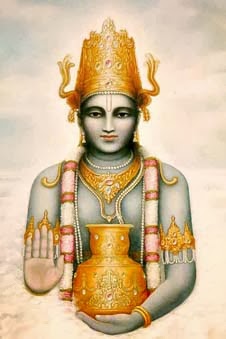
Lord of Ayurveda -Dhanvantari Stotram -Listen For Healthy Life

"Day of Dhanvantari" is observed on Triayodashi, in the month of Aasviyuja on every year to bestow perfect health which is equal to wealth.

Dhanvantari is the aspect of Natural Law which brings health and immortality. 

Maharishi Yagya performances on the Day of Dhanvantari promotes good health for everyone.

Dhanvantari Stotram in English -

 Lord of Ayurvedic Medicine

---------------------------------------

Om Sankham Chakram Jaloukaam

Dadhadamruta GhatamChaaru Dorbhicchaturbhihi

Sookshma Swacchati Hrudayaamsuka

Parivilasan Moulim Amboja Netram

Kaalaambodojvalaangam Katitata Vilasat

Chaaru Peetaambaraadyam

Vandey Dhanvantarim Tam

Nikhila Gada Vana Proudda Daavaagni Leelam

------------------------------

Meaning -- 


Salutations to him, Lord Dhanvantari, who is holding in his four hands a Conch, a Disc .a Leech and a pot of celestial ambrosia

in whose heart shines a very clear, gentle and pleasing blaze of light, which also shines all around HIS head and lotus eyes.

On the dark blue/black water his body is luminous and splendid.

His waist and thighs are covered in yellow cloth and who by his mere play destroys all diseases like a huge forest fire.

-----------------------------

Ayurveda Description --

------------

Ayurveda or " Ayurvedic medicine " ( science of life ) is a wisdom and medicine from India . In Sanskrit , the word Ayurveda is a combination of the words : "Ayur" meaning "life" and "veda" meaning "science".


Ayurveda offers a sustainable well-being in life , both individual families and society. It places man in his dimension to both physical and spiritual .

Ayurveda believes in the balance of three "elements" : 


Vata ( wind / spirit / air ) , 


Pitta ( fire / bile ) , 


Kapha ( earth / water / mucus ) . 


The concept of the Panchakarma , Pancha in Sanskrit : five and Karma :  action,  is an Ayurvedic treatment whose goal is to purify the body by causing the elimination of toxic elements from the body.

The Ayurvedic diet includes a series of recommendations , ranging from the preparation and consumption of food, good health habits for the day and night , sexual life and the rules of moral conduct .


Don't Miss to Visit   Admins Youtube Video Page

October 2, 2013

Special Trains for Durga Puja - DASARA- INDIA


ALLAHABAD: In view of the DurgaPuja festival, The railway administration had decided to run Puja special trains during DurgaPuja. These are Kolkata-AnandVihar terminal ( Delhi) special, Sealdah-New Delhi special. 


NCR spokesperson Manzar Karrar said that there is huge rush during Durga Puja festivals. The specials are being run so that passengers can get confirmed reservation


Train number 03125/03126 would run between Kolkata and Delhi (Anand Vihar Terminal). It would depart from Kolkata at 1:45 pm and go through Burdwan, Durgapur, Asansol, Dhanbad,Gomo, Kodarma, Gaya, Dehri-on-Son, Sasaram, Bhabua Road and reach Mughalsarai at 2:00 am, Allahabad at 4:35 am, Kanpur at 7:15 am and terminate at Anand Vihar Terminal at 1:50 pm. During the return journey, the train would depart from Anand Vihar Terminal at 7:50 pm and reach Kanpur at 1:45 am, Allahabad at 4:25 am, Mughalsarai at 6:45 am and terminate at Kolkata at 6:10 pm.


The train would depart from Kolkata every Saturday from October 5 to November 9 and from Anand Vihar Terminal every Sunday from October 6 to November 10. It would comprise one AC-II tier, two AC-III tier, ten sleeper and three general coaches.


Train number 03113/03114 would run between Sealdah and New Delhi. It would depart from Sealdah at 11:55 pm and pass through Burdwan, Durgapur, Asansol, Dhanbad, Gaya and arrive at Mughalsarai at 10:10 am, Allahabad at 12:15 pm, Kanpur at 3:25 pm and terminate at New Delhi at 11:30 pm. During the return journey, the train would depart from New Delhi at 11:45 pm and arrive at Kanpur at 6:40 am, Allahabad at 9:10 am, Mughalsarai at 11:50 am and terminate at Sealdah at 10:45 pm. This train would depart from Sealdah every Friday from October 4 to November 11 and from New Delhi every Saturday from October 5 to November 30. It would have one AC first class, three coaches of AC-II tier, nine coaches of AC-III tier and two coaches of pantry cars.


Don't Miss to Visit   Admins Youtube Video Page

September 22, 2013

Jagat Shri Brahma Temple Pushkar:

Jagat Shri Brahma Temple Pushkar

The simply standing Hindu temple in India devoted to Lord Brahma, the maker of the universe, the structure around the temple was built in the 14th century and stands on a high stage near Pushkar lake. Brahma is one of the Holy Trinity in Hinduism, sharing the honour with Vishnu the Preserver and Shiva the Destroyer. Though a especially huge number of temples can be establish all over India devoted to Shiva and Vishnu, there are very few temples for Brahma, this being one of the holiest one.

Marble steps guide up to the temple wherever a silver turtle lies printed in the floor facing the sanctorum. The marble floor around the turtle is littered with hundreds of silver coins embedded in the floor, and so are the walls of the temple. Images of the peacock, the vehicle of Brahma’s consort Saraswati, adorn the temple walls. Brahma here is shown in a life-size form with four hands and four faces, facing four special directons. A hans (goose, the official carrier of Brahma) spans the gateway to the temple which is crowned through a red spire. A small statue of the milk goddess Gayatri (whom Brahma married) near Brahma’s idol is called Chaumurti. Steps inside the silver-doored sanctuary lead down into a little cave which is a Hindu temple of Lord Shiva.

September 19, 2013

Hanumans Tip on Worshiping THE GOD

WHEN HANUMAN WENT to Lanka in search of Sita,

he met Vibhishana there who was also a devotee of Rama.

Expressing his anguish to Hanuman, Vibhishana said to him, “Dear

Hanuman! You are very fortunate that you are doing the work of Rama while

chanting His name and thereby you are recipient of His grace. I am also

reciting the name of Rama since a long time but I have not been able to

have His Darshan so far.” Hearing this, Hanuman said to Vibhishana, “You

have been reciting the name of Rama. But, have you ever done something

for Rama? How can you receive the grace of Rama without doing any work for Him? Mother

Sita is there in Lanka for the last ten months. Did you ever say anything to her which could

make her calm and peaceful? Did you go even once to have her Darshan? Did you think of

any way to relieve her suffering? Performance of any of these tasks would amount to service

of Rama. But you have done nothing of this sort. Isn’t it so? Then, how can you receive

the grace of Rama? I am leading my life in the service of Rama while chanting His name all

the time.”

Mere chanting of Mantras or reciting God’s name is of little benefi t. One should do God’s

work. That is why Swami always says: Dil Mein Ram, Hath Mein Kaam.

Don't Miss to Visit   Admins Youtube Video Page

September 8, 2013

HAPPY VINAYAKA CHAVITHI- GANESH CHATHURTHI

If you want to lead a life of happiness, free from troubles and difficulties, you have to pray to Ganapathi, the remover of all obstacles. There is no need to go to any temple.Vighneswara dwells in each one of you as your intelligence (buddhi) and wisdom (vijnaana). When you make proper use of your inherent intelligence and wisdom, you will be successful in life.

Vinayaka (Ganesha) drives away all sorrows, difficulties, and miseries. He is the enemy of all obstacles. He will not allow any obstacles to come in the way. He is the destroyer of obstacles. He confers happiness and peace (on his devotees). He is the master of all these powers (intellect (buddhi) and fulfillment (siddhi, self-realization). What is this siddhi? When there is purity of mind, you achieve peace (which is siddhi). Vinayaka is thus the Lord of the intellect and self-realization. Hence, every human being should acquire control over the mind ... .

Vinayaka is the Lord of all learning (vidya). Does learning mean bookish scholarship? No. Everything pertaining to the cosmos is included in the term learning (vidya). Walking, talking, laughing, sitting, eating, strolling, thinking --every kind of activity is related to learning. Vinayaka is the master of every kind of learning. Today, learning is identified with acquisition of information. But apart from knowledge of the physical world, we have many other kinds of knowledge, relating to chemistry, the fine arts and other skills.

Vinayaka is the master of every kind of knowledge. Learning is related to the intellect (buddhi). It is not mere scholarship. Familiarity with books is not knowledge. One's entire life is a continuous process of learning. Any process of inquiry is related to learning. But basically our inquiry should be concerned with finding out what is transient and what is permanent. This is true knowledge.

Hence, today, students worship Vinayaka with zeal. Vinayaka is not the one who merely comes to the aid of those who read their books, BLOGS, wallpapers & movies.

He helps everyone at every step in life's journey.

Lord Ganesh Puja Details in Telugu Version

Don't Miss to Visit   Admins Youtube Video Page

Recent Posts

Admins Youtube -Devotional Videos

Thanks and Vist us Again

Gsv Pics |Gsv Vids | Techno zip| Divine Thought | For The Sake of Us | Gsv Films | DMCA POLICY | Privacy Policy
Note: ALL THE PHOTOS,STILLS AND PICTURES FOUND IN THIS BLOG ARE FROM VARIOUS INTERNET SOURCES AND SOME ARE FROM THE PROPER RIGHT FROM THE WEBSITE OWNERS IF YOU FIND ANYTHING ILLEGAL AND YOU WANT US TO REMOVE IT FROM THIS BLOG EMAIL US TO gsvfilmsblog @ Gmail .com WE WILL REMOVE It IMMEDIATELY.... Contact Us Copyright 2011 A product of GSV Films. Actors Actress Unseen Photos!

Related Posts Plugin for WordPress, Blogger...